What it is about
Museums, archives and libraries are facing increasingly urgent questions about artificial intelligence: how to keep it consistent with their institutional mission? How to avoid it becoming mere spectacularisation? What skills are needed to adopt it in a truly sustainable way?
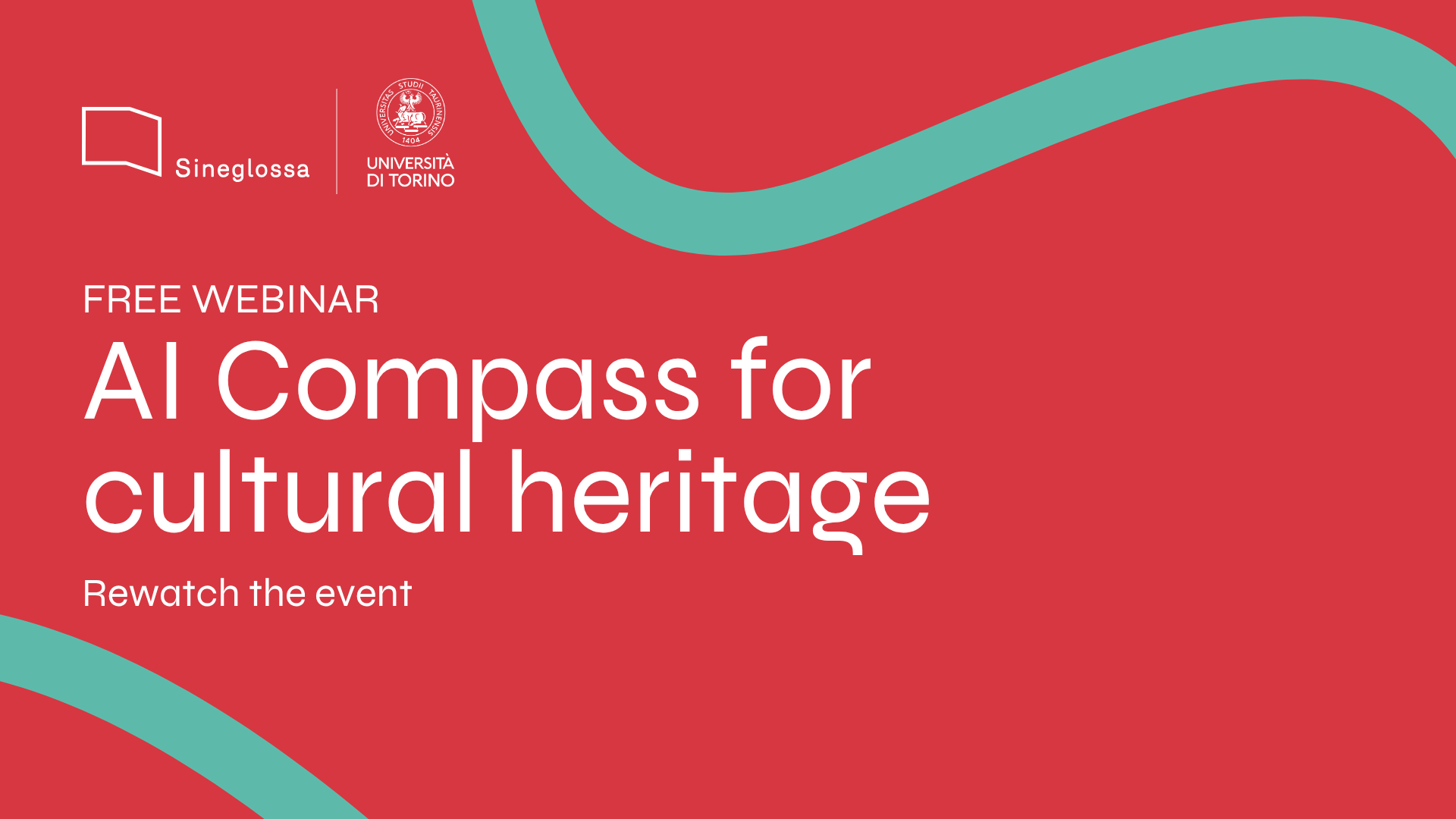
To help answer these questions, together with the University of Turin we conducted the AI Compass for Cultural Heritage – a qualitative study based on 17 interviews with professionals from the sector and 6 case study analyses of AI-based projects, with the aim of producing concrete recommendations for cultural institutions that want to adopt AI with strategic vision and ethical responsibility.
On 5 May we discussed it publicly in a free webinar, together with the authors of the research – Alessia Tripaldi (Director of Training and Research at Sineglossa), Simone Natale and Luca Befera (University of Turin) – and a number of cultural sector professionals from different fields: private foundations, museums, research centres. The event was moderated by Federico Bomba, president of Sineglossa.
The topics discussed
The event opened with the contributions of Simone Natale, who introduced the research context in which AI Compass was developed, and Alessia Tripaldi, who presented its form and contents, drawing attention to the territorial and project-based diversity of the case studies and the recurring threads found in the choices and dynamics around AI adoption:
The deepest reason behind such interventions can be summed up in a word that comes up often in the interviews, which is "democratisation of knowledge" – an intention to open up heritage by simplifying language. And simplifying doesn't mean trivialising; it means changing the narrative [...], shifting the interaction from a static experience to a dynamic one [...], the desire to stimulate curiosity, to make engagement with heritage active.
Alessia Tripaldi, author of the reasarch "AI Compass per il patrimonio culturale"
We then turned to Anna Maria Marras (Chair of AVICOM, ICOM International Committee for Audiovisual, New Technologies and Social Media), placing accessibility at the centre – not only of content, but of the knowledge needed to use new technologies in an informed way. Cultural institutions, by virtue of their social mission, are not merely users of digital tools: they are called to act as mediators in the use of these technologies with their audiences.
With Emanuela Totaro (Secretary General, Fondazione Kainòn, Rome) the conversation broadened to include the ethical dimension: not ethics as a constraint, but as the set of conditions within which technological innovation remains coherent with an organisation’s cultural mission. In this sense, documents such as the AI Compass and the Carta di Benevento play a concrete orienting role for the sector.
Luca Scoz and Carlo Maiolini (MUSE – Museo delle Scienze di Trento) brought two complementary – and in some ways opposite – experiences from the Museum of Science in Trento. The first is UranIA, the conversational assistant developed by MUSE to offer the public a direct, specialised source of knowledge about the museum’s collection and themes – an alternative to “commercial” AI, built and governed internally. The second is a more experimental project, arriving in autumn with the temporary exhibition IO & AI – Prospettive di co-evoluzione fra intelligenza umana e artificiale: a chatbot that is not the museum’s official voice, but a deliberately freer agent, capable of hallucinating and confronting visitors with an unexpected interaction. Two different ways of engaging with AI, reflecting two different questions an institution can ask itself.
From the conversation with these professionals, something emerged clearly – something we also encounter in the direct work we carry out with museums and archives: the most urgent question is not whether to adopt AI, but what conditions – organisational, curatorial, ethical – need to be in place for that adoption to make sense and remain sustainable over time.
The final part of the event made space for questions from the audience, which brought concrete challenges to the table: how to govern AI when it intersects with processes still underway, such as the digitisation of heritage; how institutions can maintain an ongoing dialogue with the research community; what the value boundaries of a generative system are when it is asked to embody historical perspectives far removed from contemporary sensibilities. On the technical side, there was curiosity about UranIA’s architecture, the embedding models used, and visitor usage data.
Discover AI Compass
The AI Compass for Cultural Heritage is available to download for free. It contains an in-depth analysis of the Italian landscape, the key tensions cultural institutions are navigating in the adoption of generative AI, and a set of operational recommendations for those who want to move forward with method.
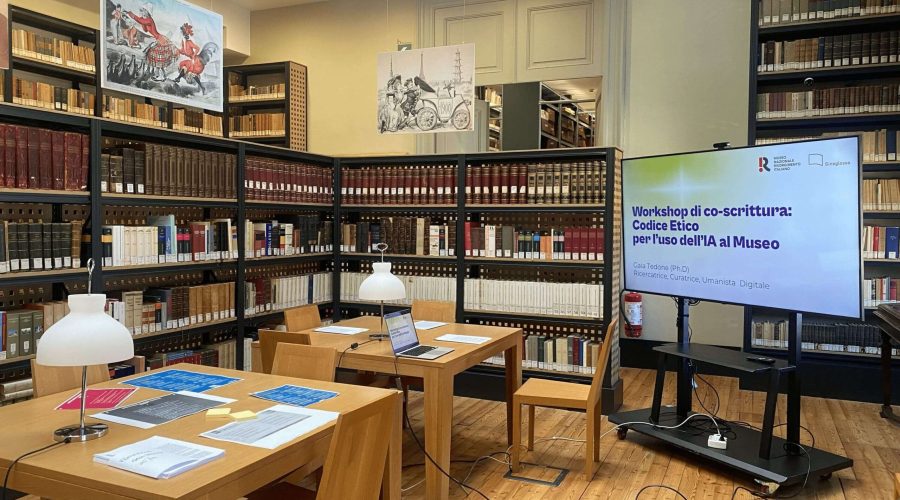
Want to see how this approach translates into a concrete path with a museum? Read about the work we carried out with the National Museum of the Italian Risorgimento.
Read also
- Insights, Insights, News, News
- Events, New Projects, News
Do you work with a museum, an archive or a library?
The research and the conversations of 5 May confirmed what we observe every day in our work with cultural institutions: adopting AI in a conscious way takes time, method, and a reflection that starts from content and people – not from technology.
If you are considering whether and how to integrate generative AI tools into your institution – or simply want to understand where to begin – we can think it through together.