What it is about
Artificial Intelligence has already entered the museum visiting experience: audiences use it to find their way, delve deeper, and interpret cultural contents. For cultural venues, the question is no longer whether to adopt it, but how to govern it in a way that is consistent with their values, heritage and audience expectations.
In this context, Sineglossa helped the National Museum of the Italian Risorgimento (Museo Nazionale del Risorgimento Italiano) in developing a Manifesto for the conscious use of AI: an explicit stance on the role of these technologies in museums, which places it among the first institutions in Italy to adopt an ethical framework dedicated to artificial intelligence.
The manifesto is the result of a broader consultancy and training path designed and led by Sineglossa, developed through the Museum’s participation in the Tap project – Tutoring e Accompagnamento Progetti, realized with the training support of the project Dicolab. Cultura al Digitale promoted by the Ministry of Culture – Digital Library as part of the Pnrr Culture 4.0, created by the National School of Cultural Heritage and Activities and funded by the European Union – Next Generation Eu.
- Events, New Projects, News
Not only consultancy, but dialogue and co-design
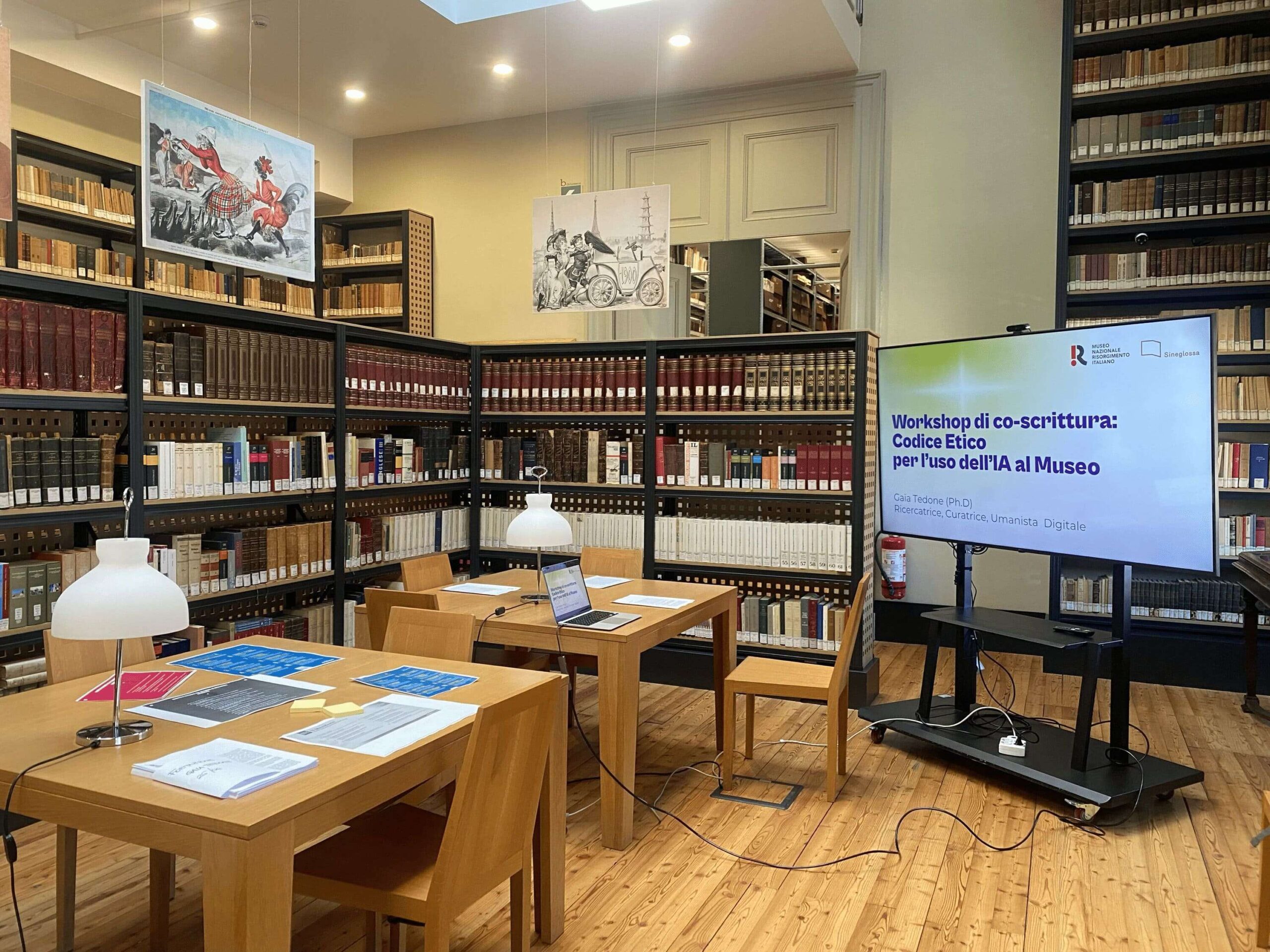
The path was designed together with the staff of the National Museum of the Italian Risorgimento through moments of training, comparison, and co-design. The goal was not to introduce a technology, nor to train the team in its use; but rather to help the cultural institution understand what AI can do in a museum context, which aspects it can enhance, what limits it entails, and what skills are necessary to manage it.
Within this path, we were specifically asked for a feasibility analysis of an AI-based digital tool capable of supporting the Museum’s visiting experience, improving orientation, content accessibility, and audience engagement.
The path developed as follows:
We spoke with museum staff to understand how the institution works, the narrative logic of the exhibition path, and the role of digital within the visiting experience. Among the meetings in this phase, we held a workshop to create a symbolic image of the museum through a visual and metaphorical feedback activity (a service based on the collective elaboration of a collage which Sineglossa has recently designed and conducted for Deepblue and Confartigianato Ancona).
Some theoretical lessons on the basics of AI and the illustration of museum best practices allowed for the construction of a shared knowledge base and the development of a critical understanding of AI within the team.
of the visiting experience
di un eventuale strumento digitale
of an AI-based system
for chatbot training (captions, panels, audio guides, editorial materials)
of an AI-based system
by involving different museum figures – curatorial, educational, archival, and digital – different points of view and skills were valued in a co-design logic, avoiding the risk of developing standardized digital solutions inconsistent with the museum’s specific identity, languages, and needs.
What is left to the museum
At the end of the training and consultancy path, we delivered to the Museum:
A feasibility analysis
that provides scenarios and conditions for the potential development of an AI-based digital tool – specifically a chatbot – designed as a support for the visiting experience, capable of orienting, accompanying, and making complex content more accessible.
A manifesto for the conscious use of AI
developed together with the museum, representing one of the most relevant outcomes of the process: an explicit stance regarding the role of artificial intelligence in cultural venues. With this document, the National Museum of the Italian Risorgimento is among the first in Italy to adopt an ethical framework dedicated to AI, defining clear principles to guide its use in consistency with its own cultural and scientific mission.
How we work with museums, archives, and libraries
The path realized with the National Museum of the Italian Risorgimento reflects the method that Sineglossa applies in training and consultancy paths dedicated to the conscious adoption of AI in cultural venues:
- we start from an in-depth analysis of the context and the audiences;
- we build internal skills through training and support;
- we co-design AI-based digital tools together with the institution’s professionals;
- we work on content and sources even before technology;
- we integrate ethical reflection and project development;
- we arrive at testable and sustainable prototypes.
AI is not the starting point, but one of the possible tools to improve access, understanding, and the relationship between heritage and audiences.
👉 This type of path is designed to accompany museums, archives, and libraries that are considering whether and how to integrate AI into their processes and want to adopt their own ethical framework to govern its use consciously.