What it is about
The Coastal Sustainability Competence Framework developed by Stories of the Sea, the European project born to address the challenges of sustainability and climate change in coastal communities, is now online. Stories of the Sea is co-funded by the EU Erasmus+ programme and developed by Sineglossa (Italy), Aalborg University (Denmark), Balgarska Fondatsiya Bioraznoobrazie – BioXcape (Bulgaria), VisitLæsø (Denmark), Stimmuli for Social Change (Greece), and Coastal Union Germany (EUCC-D) (Germany).
The framework was developed through focus group interviews with VET trainers and educators active in coastal communities across five European countries. It is designed to help trainers integrate coastal sustainability into vocational and community-based learning in a practical, inclusive, and grounded way – combining ecological, social, and economic perspectives. It builds on key EU reference frameworks including the UN Sustainable Development Goals, the New European Bauhaus, GreenComp, and the EDUS framework – another output of the homonymous European project, a competence framework developed by Sineglossa and its partners to integrate sustainability into VET programmes through a problem-based learning approach, designed for trainers across a broad range of educational contexts.
- Insights, News
Why a framework specifically for coastal communities?
Coastal areas across Europe are facing a set of converging, urgent challenges: the decline of traditional maritime activities, the pressures and opportunities of expanding tourism, and the growing impacts of climate change — from sea-level rise to biodiversity loss. These are not abstract problems. They shape the daily lives and livelihoods of the people who live and work by the sea.
And yet, as trainers working in these contexts told us:
"Unless you have a marine biologist as a teacher, these topics rarely come up in school. Everyone knows trees do photosynthesis, but who knows that algae and marine plants do too?"
Focus group participant, Greece, 2025
The framework responds to this gap, giving trainers the concepts, tools, and confidence to bring coastal sustainability into their specific VET field. In fact, the framework is grounded in a specific understanding of what a sustainability competence means:
"A sustainability competence empowers learners to effectively address environmental, social, and economic challenges, to take action that positively contributes to sustainable development."
Huulgaard et al., 2025
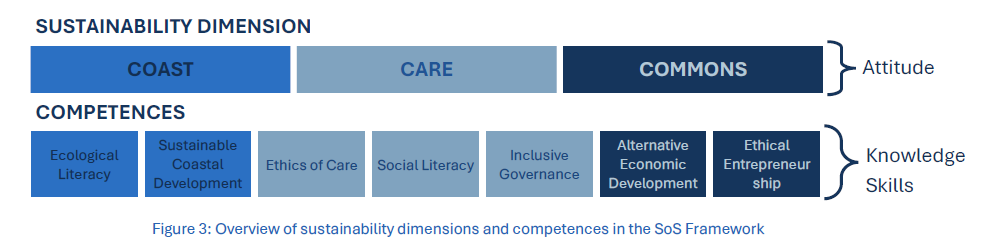
Each competence in the framework is built around three interconnected components:
- Knowledge: understanding concepts and systems;
- Skills: the ability to apply that understanding;
- Attitudes: the dispositions and mindsets that learners carry beyond education, into their professional and personal lives.

Three dimensions: Coast, Care, and Commons
The framework organises coastal sustainability into three core dimensions, each with its own set of competences:
- Coast focuses on the relationship between natural systems and human activity — from ecological literacy and marine biodiversity to sustainable coastal development practices that draw on local knowledge, culture, and tradition;
- Care addresses social sustainability: the ethics of collective responsibility, social literacy, and the governance processes that shape whether coastal development is inclusive or exclusionary;
- Commons takes on economic sustainability – questioning dominant business models and exploring alternative forms of economic development and ethical entrepreneurship suited to the unpredictability and seasonality of coastal economies.
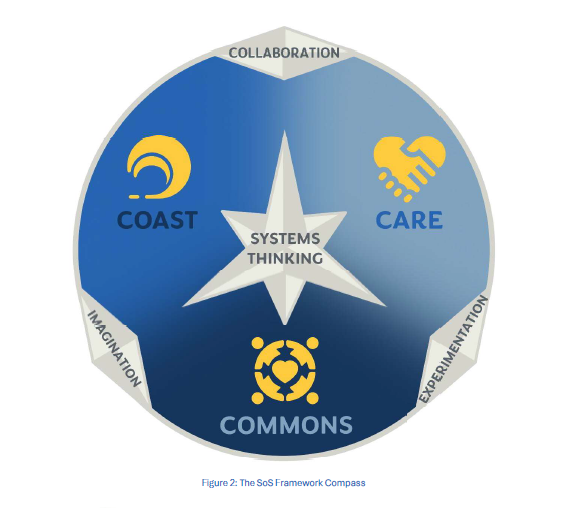
Running across all three dimensions are four enablers – ways of thinking and doing that make it possible to actually teach and apply these competences in any VET context:
- Systems Thinking – understanding how ecological, social, and economic changes are interconnected
- Collaboration – working across disciplines and with local stakeholders
- Imagination – envisioning alternative futures and challenging existing assumptions
- Experimentation – turning ideas into action through structured trial, reflection, and iteration.
Like EDUS, the framework offers three progressive competence levels – Basic, Intermediate, and Advanced – allowing trainers to adapt it to their learners’ starting point and their programme’s scope. The framework also includes a self-assessment grid that learners can complete before and after training, giving trainers a concrete tool to measure progress and adjust their approach accordingly.