What the archetypes are
How are skills such as empathy, strength, curiosity, or wisdom represented today?
For years, within the Be Your Hero methodology, we have been using illustrated archetypes to help teenagers and young people recognize their own “superpowers”: relational, emotional, and soft skills that are often difficult to name, but which emerge in everyday behaviors, relationships, and choices.
Be Your Hero is the training project designed by Sineglossa to train life skills through collective experiences of sport and art. The archetypes are one of the symbolic tools of the path: they help participants reflect on themselves, observe their own behavior through the eyes of others, and narrate episodes of their lives starting from shared images and references.
Over the last few months, while working on a new edition of the campus, we realized that those archetypes no longer fully represented the project. This is why today they are changing, becoming ecosystemic, zoomorphic, less anthropocentric, and closer to the imagination of the new generations.
Where the archetypes come from
In building this methodology and applying it to different target beneficiaries, we used characters and narrative references inspired by cinema and TV series to explain archetypes such as the explorer, the sage, the guardian angel, or the warrior.
The goal has always been to simplify complex concepts through narrative thinking: using recognizable and well-known figures in common culture to help participants tell their stories, recognize recurring behaviors, and reflect on their own life skills.
Why we decided to change
The redesign of the new archetypes stems from two needs.
On one hand, we realized that some visual and narrative references were becoming less and less shared by the project’s beneficiaries. Through discussions with educators trained by Sineglossa in the Be Your Hero methodology, we noticed that many of the cultural references used to describe the archetypes were no longer recognized.
When we asked what their spontaneous narrative references were, and we started reasoning by archetypal characteristics, new shared imaginaries emerged: for example, Luffy from One Piece as an untamed explorer, or Yoda and Albus Dumbledore as figures of wisdom.
We understood that the potential of archetypes is expressed when they help people tell their stories in a personal way, not when they propose a model to imitate. This is why we chose to bring those references into the methodology’s revision process.
In the second place, the redesign responds to the desire to overcome overly stereotyped representations of certain personal and character traits. Strength, for instance, took the form of physical strength in the old archetypes and was personified by a fighter. Instead, we wanted to move away from human, individualistic, or competitive imaginaries, which are distant from the way we imagine strength, care, relationship, and transformation today.
The new archetypes
We therefore asked ourselves: how can we represent strength without using warlike metaphors? And empathy without reducing it to a human stereotype? How can we build characters less tied to gender stereotypes and closer to an ecosystemic and relational vision? How can we step out of an overly anthropocentric vision?
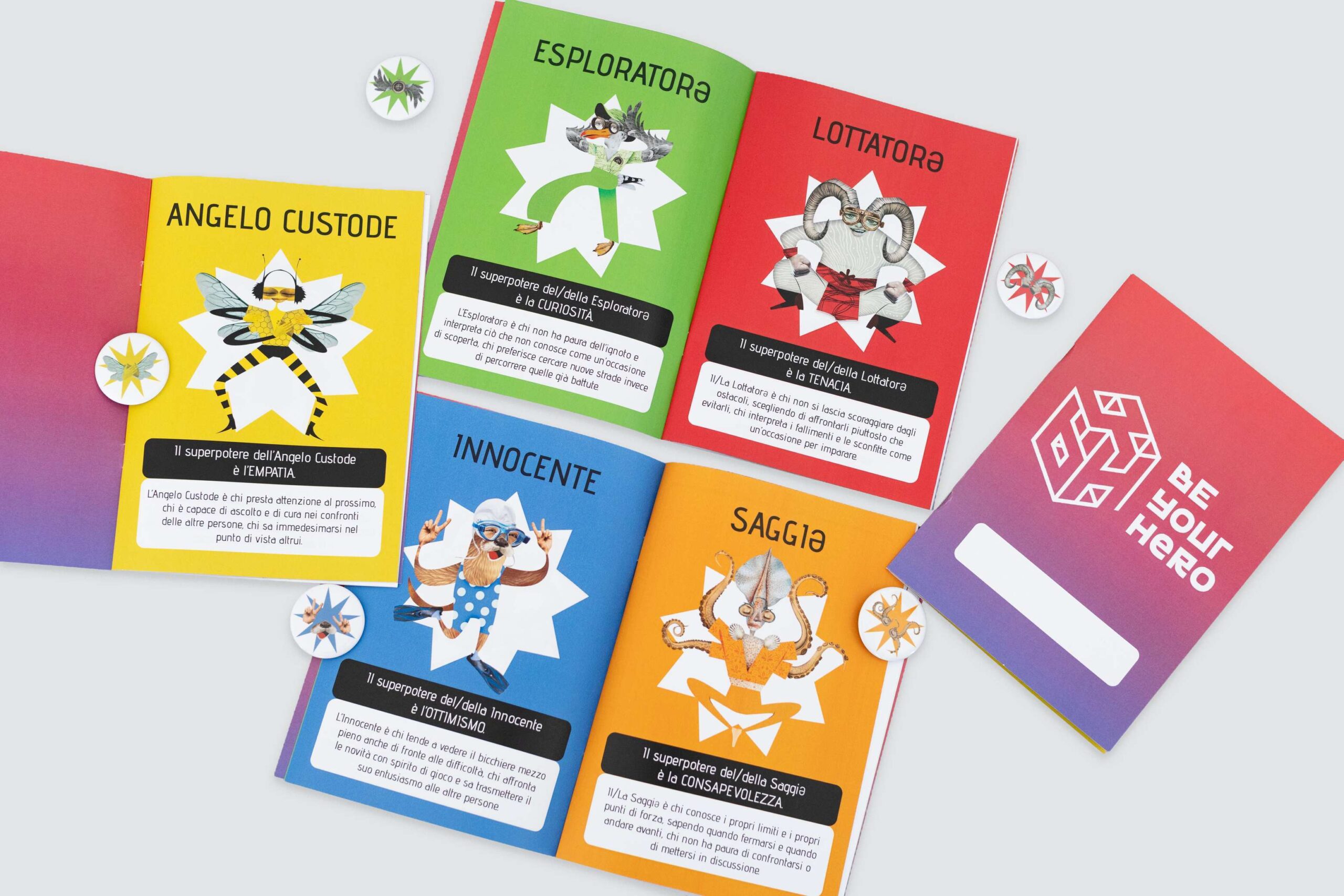
From these reflections, the new Be Your Hero archetypes were born, drawing inspiration from the animal and natural world:
- the Octopus represents wisdom and shared intelligence;
- the Albatross becomes a symbol of curiosity and observation;
- the Ram speaks of courage and energy, without the language of combat;
- the Bee represents collective care and empathy;
- the Otter recalls play, enthusiasm, and trust.
*placeholder slider prima/dopo*
Not just a restyling, but co-design
The work on the archetypes was not a simple graphic restyling. Each character was born through weeks of discussion between educational design, illustration, and collective experimentation.
The keyword that guided the process was “readability”: in redesigning the archetypes, we asked ourselves: “Do people immediately understand what they are looking at? can they identify with it? can they use it to tell their own story?” One of the main difficulties was building figures perceived as neutral, avoiding a sharp bias toward masculine or feminine codes.
As designer Eleonora Rossi says:
“The greatest difficulty was creating neutral characters. I tried to include as many elements as possible within the same archetype, combining characteristics traditionally considered masculine or feminine, but also pushing further and further on the animal component to move away from an overly human representation.”
Eleonora Rossi, designer of the archetypes of Be Your Hero
For this reason, each archetype has become a layered composition: eyes, mouths, postures, paws, feathers, tentacles, wings, and accessories coexist in the same character, creating hybrid and not completely definable identities.
Among all the archetypes, the Guardian Angel was the one that required the most revisions. In the early versions, the bee was barely perceptible: the character seemed closer to a spider or a frog, and the posture appeared ambiguous, almost dancing.
Through feedback from the team, the character was progressively transformed: the raised hands became a gesture of embrace, the face was brought closer to the imagery of a bee, the legs took on the typical striped pattern of the insect, and the entire archetype became more readable, neutral, and reassuring.
As Eleonora Rossi points out:
“At the beginning, some archetypes had more unsettling features. I think my personal fear of insects, especially bees, also played a part. The feedback helped me step out of my personal vision and see the collages from an external perspective.”
Eleonora Rossi, designer of the archetypes of Be Your Hero
A further evolution of the graphic process occurred when the archetypes stopped being isolated images and became a system. Seeing them together made it possible to build visual consistencies, balances, and shared languages:
- facial accessories linked to the characteristics of the archetype
- recurring patterns
- shared palettes
- balance between the illustrated and photographic components
- continuous balancing between human and animal
Each character thus acquired its own distinctive element: the Fighter’s shield-mask, the Sage’s glasses, the Explorer’s binoculars, the Guardian Angel’s headphones, the Innocent’s goggles. Details that serve not only to make the archetypes recognizable, but also to immediately suggest behaviors, attitudes, and ways of being in the world.
The most important test, however, came from the participants. After weeks of revisions, feedback, and internal discussions, the new archetypes were used during an online training session with fifty teenagers from the Bella Storia. La tua project. We were interested in understanding if those symbols actually worked: if they were readable, if they triggered identification, if they helped name behaviors and experiences. And the answer came during the activity: the participants understood the new archetypes and were able to recount episodes in which they had used those “superpowers” in their daily lives.
It was then that we realized the redesign was not just an aesthetic work. It had functioned as a pedagogical device.
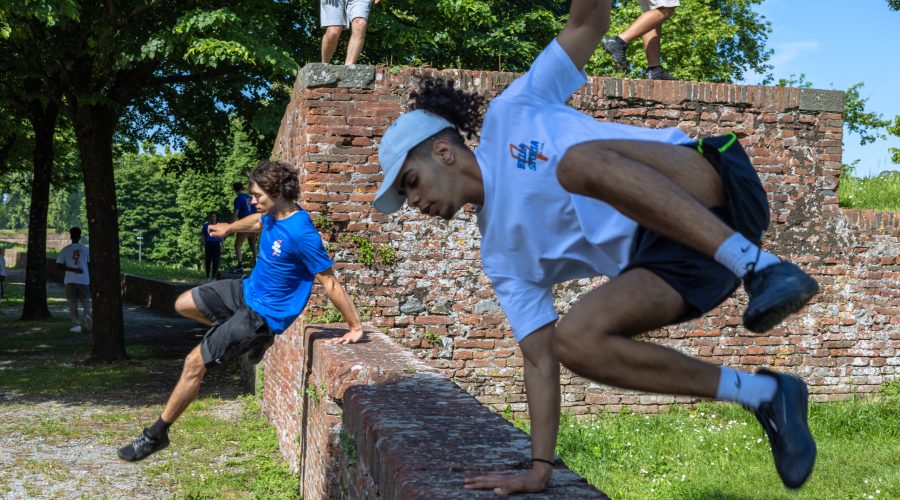
- Insights, News
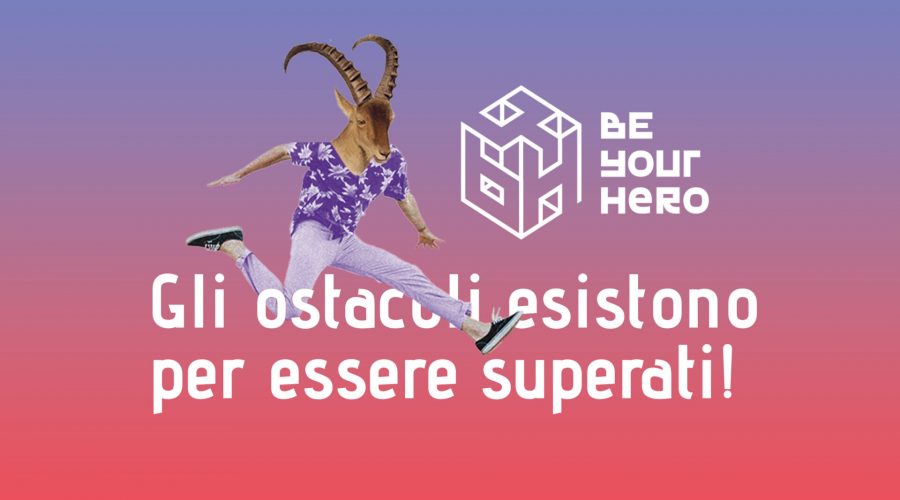
The next editions of Be Your Hero
The new archetypes will accompany the next edition of the Be Your Hero campus within Bella Storia. La tua, the program by Fondazione Unipolis which, since 2022, has been supporting young people from Campania and Calabria in a three-year journey of personal and social growth.
A project created to give trust to young people, enhance their talent, and offer them concrete tools to become conscious citizens, capable of facing the challenges of adulthood and contributing to the change of the communities they live in. Each edition accompanies participants in a three-year journey that intertwines financial support, training, mentoring, and local experiences.