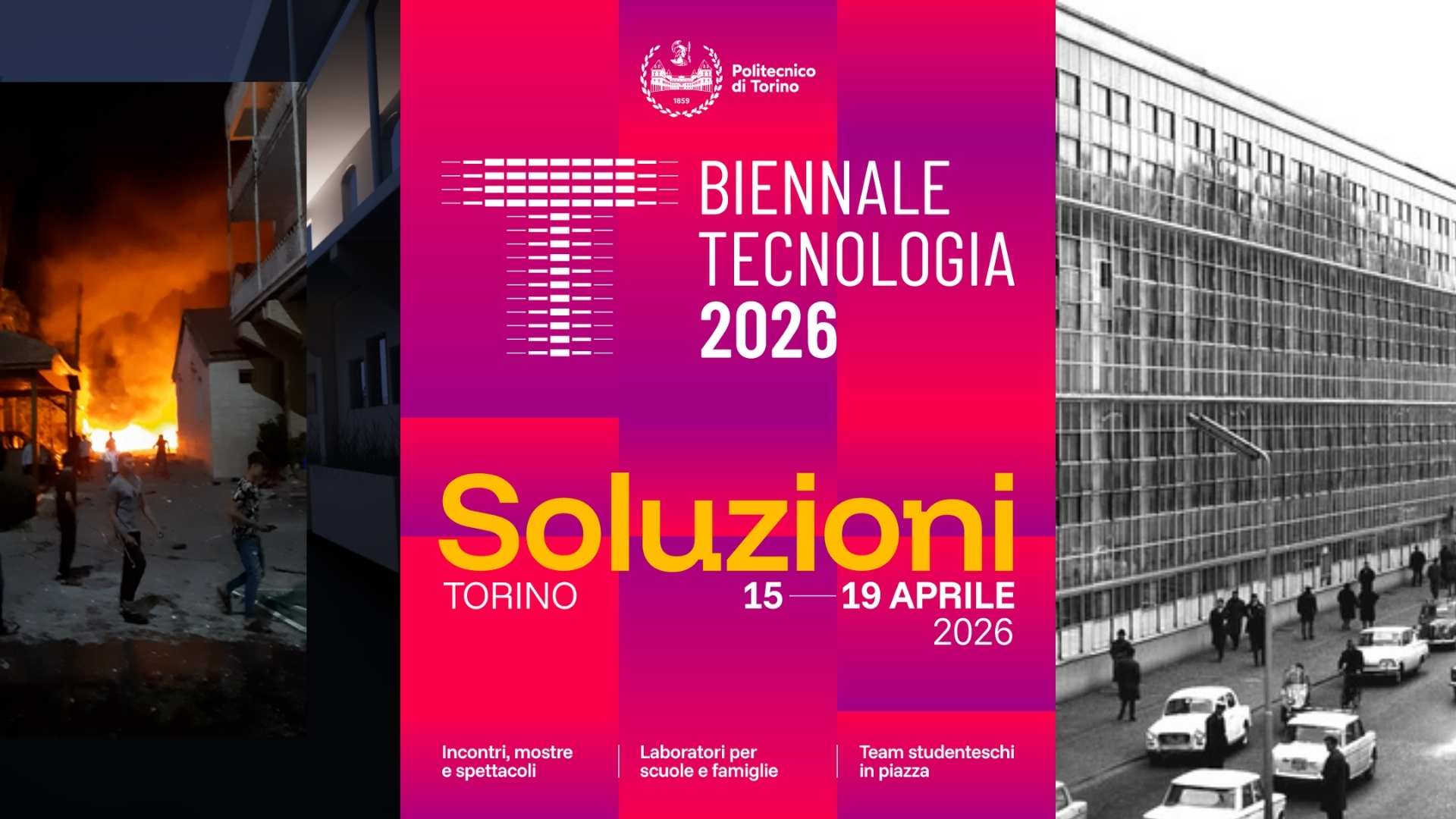
On the cover:
‘When it Stopped Being a War’, A still image from video of the aftermath of the blast recorded by Dr Ghassan Abu-Sittah, placed within FA’s 3D reconstruction of al-Ahli Hospital. (Forensic Architecture, 2024).
Glass façade of the Olivetti plants in Ivrea, commonly known as “Nuova Ico,” Photo by Associazione Archivio Storico Olivetti, Ivrea.
What it is about
Sineglossa is taking part in the fifth edition of Biennale Tecnologia, the project of Politecnico di Torino dedicated to the relationship between technology and society. Sineglossa supports Federico Bomba (President of Sineglossa) in the curation of the exhibitions Framing Problems and Dati Sensibili (Sensitive Data), while also contributing to the characterization and user experience of one of the installations on display: a conversational agent trained on materials from the Associazione Archivio Storico Olivetti and the magazine Mangrovia.
The Framing Problems exhibition
Co-curated by Federico Bomba (Sineglossa) with Bernardo Follini (Fondazione Sandretto Re Rebaudengo), Framing Problems moves from an observation: contemporary crises cannot be isolated, they are interconnected. Environmental, social, geopolitical, and technological issues are intertwined, rendering linear interpretations and purely technical solutions ineffective. In this context, the exhibition shifts the focus from problem-solving to problem-framing: before seeking solutions, it is necessary to examine how problems are constructed, made visible, thus addressable.
The artworks, exhibited across six Turin-based cultural institutions, function as “attention devices”: they invite viewers to slow down, suspend the daily flow, and critically observe the contradictions of our digital present. International artists such as Forensic Architecture, Hito Steyerl, Ian Cheng, Xin Liu, Katja Novitskova, Martyna Marciniak, Diego Marcon, and Roberto Fassone challenge established narratives, opening new ways to interpret themes such as public truth, the circulation of images, the instability of technological systems, and the construction of consensus.
The Dati Sensibili exhibition and the Chatbot OLO
Dati Sensibili (Sensitive Data), curated by Federico Bomba and hosted at the Museo Nazionale del Risorgimento (National Museum of the Italian Risorgimento), stems from a collaboration with the Associazione Archivio Storico Olivetti to question the present through three founding themes: city, technology, and labor. The exhibition starts from a clear premise: before becoming datasets, data were experience, human labor, and decisions. The exhibition path alternates between archival materials and Olivetti machines, making the materiality of knowledge and its stratification over time tangible. The analog experience concludes in the Sala Plebisciti with a highly experimental encounter. Visitors will have the opportunity to interact with OLO, a chatbot developed by TIM Enterprise with an interface created by the Possible Entanglements Lab of the Politecnico di Torino and trained on materials from the Olivetti Archive and the contents of Mangrovia – a digital magazine exploring stories of technology, culture, and society.
Sineglossa has curated the characterization and user experience of OLO to ensure it is neither a traditional assistant providing definitive answers nor an avatar simulating historical thought. Instead, it is a non-human interlocutor which uses data to stimulate questions, connections, and reflections on the present. Sineglossa’s work focused on defining its tone, conversational behavior, and interaction modes to avoid both the “oracle” effect and a purely functional one. Around OLO, a program of public dialogues dedicated to labor, the city, and design will take place, where the agent interacts with researchers and scholars.
Programmed talk
Opening talk of “Framing Problems”
📆Wednesday, April 15, 2026
📍 Fondazione Sandretto Re Rebaudengo, Via Modane 16, Turin
🕡 7:00 PM
Free entry while seats last.
👥 Speakers:
- Patrizia Sandretto Re Rebaudengo,
- Guido Saracco,
- Xin Liu,
- Diego Marcon,
- Massimiliano Gioni,
- Hans Ulrich Obrist,
- Federico Bomba,
- Bernardo Follini
Art within the Folds of the Digital Present
📆 Friday, April 17 2026
📍 Foyer del Toro, Teatro Regio, Turin
🕡 4:00 PM
Free entry while seats last. Simultaneous translation provided.
👥 Speakers (artists from the Framing Problems exhibition):
- Hito Steyerl
- Martyna Marciniak
- Roberto Fassone
Moderated by Federico Bomba, co-curator of the exhibition.
Sensitive Data: From the Archive to Contemporary Knowledge Production
📆 Friday, April 17, 2026
📍 Sala Codici – Museo Nazionale del Risorgimento Italiano, Turin
🕡 6:00 PM
Free entry while seats last.
👥 Speakers:
- Anna Maria Marras, Researcher in Librarianship and Archival Science, University of Turin
- Gaetano Adolfo Maria di Tondo, President of Associazione Archivio Storico Olivetti
- Elisa Alessio, Head of Service Innovation at TIM Enterprise
- Alessandro Bollo, Director of the Museo Nazionale del Risorgimento Italiano
Public Dialogues with OLO Chatbot
curated by THESEUS Research Center – Technology, Society and Humanity, Politecnico di Torino. 📍 Sala Plebisciti – Museo Nazionale del Risorgimento Italiano, Turin
📆 Saturday, April 18, 12:00 PM
The Future of Work
AI can transform cognitive labor—from writing to information analysis, and from design to programming—while advanced robotics impact manual activities. The debate explores its effects on distribution, substitution versus enhancement, wages, and inequality, as well as its impact on work quality.
👥 In dialogue with OLO:
- Gregorio Buzzelli, Politecnico di Torino
- Matteo Tubiana, Politecnico di Torino
- Armanda Cetrulo, Scuola Superiore Sant’Anna (Pisa)
📆 Saturday, April 18, 5:00 PM
From the Urban Factory to Data Centers: Making and Living the City in the Age of Digital Infrastructure
In the 20th century, the factory was a cornerstone of the urban fabric. Today, tech giants materialize through massive data centers. This meeting reflects on living the city in the age of digital infrastructure.
👥 In dialogue with OLO:
- Federica Joe Gardella, Politecnico di Torino
- Rossano Schifanella, University of Turin
- Enrico Giacopelli, GStudio
📆 Sunday, April 19, 5:00 PM
The Relevance of Design: Past, Present, and Future
Olivetti experience was defined by meticulous attention to design, not just for products but for communication and workspaces. What remains of that experience today? Is the Olivetti approach now widespread outside the factory – in other sectors?
👥 In dialogue with OLO:
- Elena Dellapiana, Design Historian, Politecnico di Torino
- Matteo Moretti, Information Designer, Sheldon Studio and Università di Sassari