What it is about
A deck of cards can be a good starting point for talking about artificial intelligence and disinformation. That is the idea behind the AI Glossary: 104 cards to print and cut out that explain the key terms of AI and media manipulation, with no technical background needed. The glossary was created as part of fAIr Media, the European educational project on media literacy in which we are partners alongside Ars Electronica and Baltan Laboratories.
It is designed for educators, trainers, cultural mediators and anyone working in media education. It can be used to open a workshop, start a classroom discussion or bring different generations into conversation. It is in English and can be downloaded for free.
What the AI Glossary is
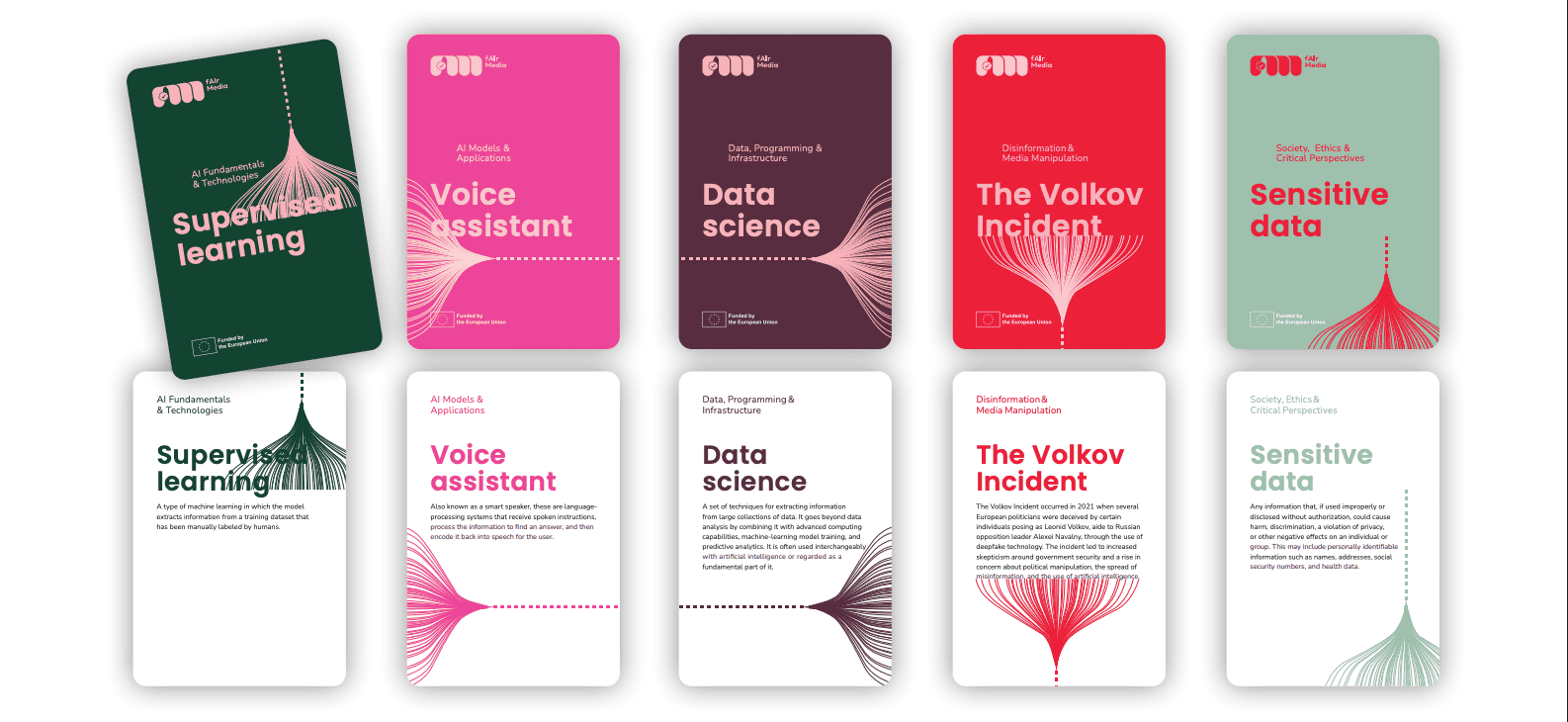
The 104 cards are divided into five colour-coded categories: Disinformation & Media Manipulation, AI Fundamentals & Technologies, AI Models & Applications, Data, Programming & Infrastructure, and Society, Ethics & Critical Perspectives. Each card has the term on one side and its definition on the other.
The terms range from basic concepts, such as algorithm, token or neural network, to information manipulation techniques, such as clickbait, information laundering and media spoofing, and the strategies to counter them, such as debunking and prebunking. The last category opens up The terms range from basic concepts, such as algorithm, token or neural network, to information manipulation techniques, such as clickbait, information laundering and media spoofing, and the strategies to counter them, such as debunking and prebunking. The last category opens up social and ethical questions: bias, digital divide, explainability, and ghost work, the largely invisible human labour that keeps automated systems running. bias, digital divide, explainability, and ghost work, the largely invisible human labour that keeps automated systems running.
The cards can be printed at home on A4 sheets and cut out, or produced by a print shop for a sturdier set. The materials also include a box to print, fold and glue to store them.
How to use it in a workshop
There is no single right way to use the cards. The accompanying guide suggests a few activities: drawing one card per category and explaining the terms in your own words, guessing a term from a definition read aloud by someone else, or drawing three random cards and looking for a link between the concepts. Another option is to connect each term to an everyday situation: at school, at work, on social media, in the news.
In a classroom, small groups can prepare a short presentation or a drawing about their terms and then explain them to the others. In an intergenerational meeting, the cards become a way to compare how people of different ages relate to technology.
The glossary also comes with the AI Memory Game, a set of 30 cards, six per category. Each card shows one term and the definition of another: players have to find the right matches and build a chain of connected concepts. It can be played alone, in teams or all together, even against the clock.
fAIr Media is funded by the European Union under the CERV programme (Citizens, Equality, Rights and Values), grant agreement no. 101147977. Views and opinions expressed are those of the author(s) only and do not necessarily reflect those of the European Union or the European Education and Culture Executive Agency (EACEA). Neither the European Union nor EACEA can be held responsible for them.