What is about
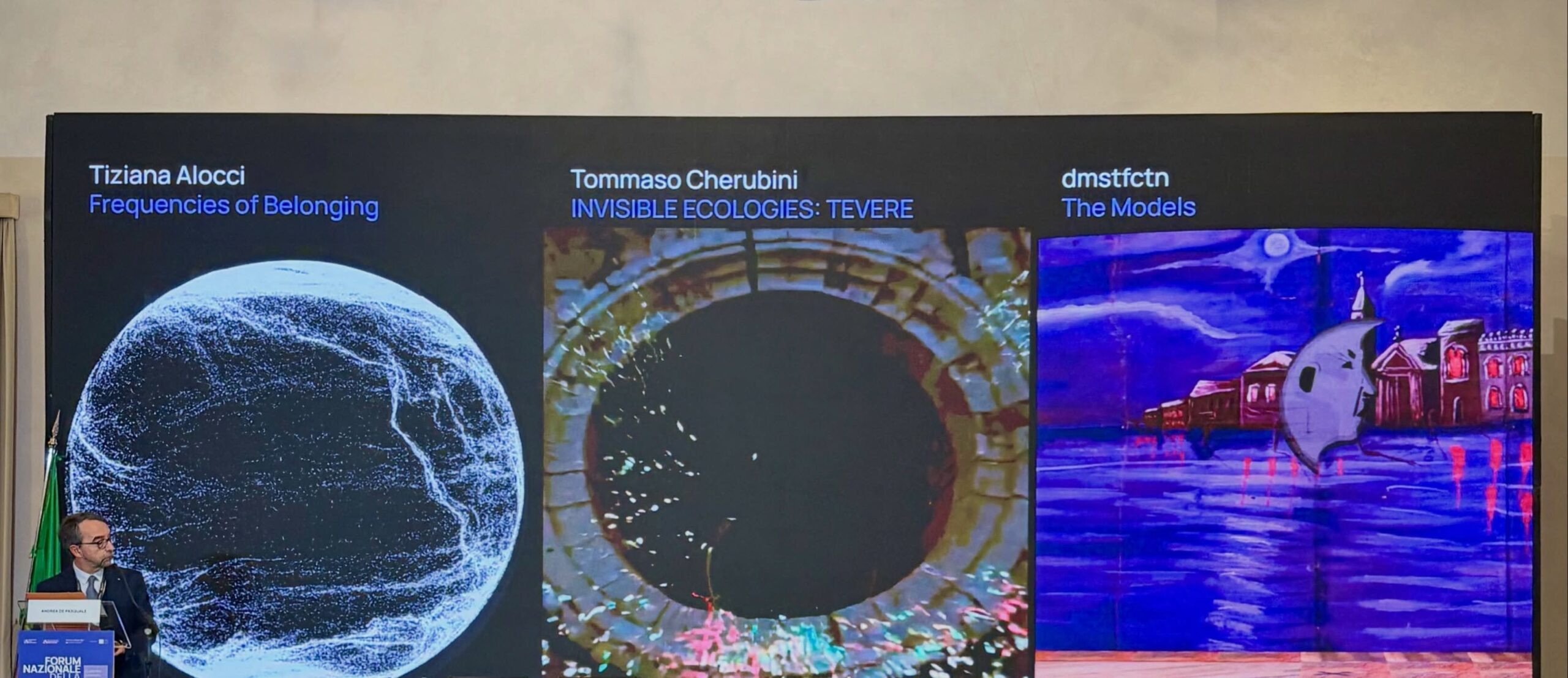
The Models, the interactive audiovisual installation by the artist duo dmstfctn that we curated, has won the first prize of the Ecomic Digital Art Award 2026. The award is an initiative of the Italian Ministry of Culture, and its first edition received 130 works from 24 countries. Until 8 December 2026 The Models is on show in Rome, at the Museo Nazionale Romano – Palazzo Massimo, in La grande trama. Il patrimonio culturale nell’era digitale, alongside the other selected works.
dmstfctn is a duo based in London and Berlin, formed by Francesco Tacchini and Oliver Smith. They explore complex systems through audiovisual performances, immersive installations, films and video games, replicating these systems together with audiences and telling new stories about them. They have exhibited and performed at venues including TANK (Shanghai), HEK (Basel), Somerset House (London) and Mattatoio (Rome), and have collaborated with the Alan Turing Institute and the Leonardo supercomputer. They are currently n-Space Fellows at Somerset House Studios.
The work was developed during an artist residency at DAMA Tecnopolo in Bologna, within the European project European Digital Deal, in collaboration with CINECA and ART-ER, starting from the collections of two museums in Emilia-Romagna. It premiered in February 2025 at ART CITY Bologna, during ARTEFIERA, as part of The Next Real, Sineglossa’s programme on the relationship between art and artificial intelligence. It has since been shown at SOLO contemporary (Madrid), Centro de Historias (Zaragoza), Adapter (Budapest) and Kerekdomb Festival (Tállya).
The work is under the patronage of the Emilia-Romagna Region, with the support of the Region’s Cultural Heritage Department. European Digital Deal, the project in which it was created, is co-funded by the Creative Europe programme of the European Union.
Read also
- Insights, News
The award and the exhibition in Rome
The Ecomic Digital Art Award is an initiative of the Italian Ministry of Culture that recognises the role of artistic creativity in cultural innovation. Its aim is to turn the past into material for new interpretations and to open cultural heritage to languages, experiences and perspectives still unexplored. Its first edition received 130 works from 24 countries across five continents; for the works considered most deserving, the Digital Library will start the acquisition procedure.
The selected works are on show at the Museo Nazionale Romano – Palazzo Massimo in Rome, in La grande trama. Il patrimonio culturale nell’era digitale, open until 8 December 2026.
How The Models works
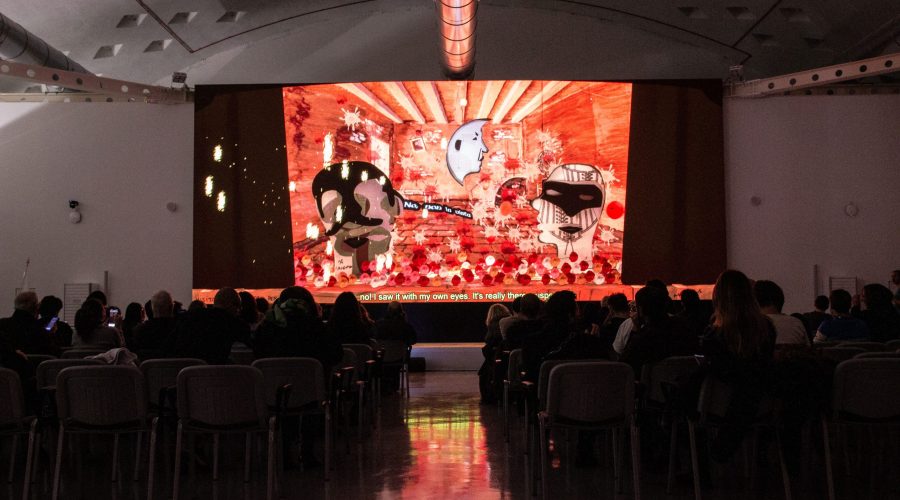
The Models draws on two digitised collections: 64 puppet theatre backdrops from the Museo dei Burattini in Budrio and the twentieth-century paper cut-outs from the Museo Ferrari in Parma, from which dmstfctn took the masks. Heritage becomes the stage of a virtual theatre, where Arlecchino, Balanzone, Colombina, Pantalone, Brighella and Pulcinella improvise sketches in the style of the Commedia dell’Arte.
The masks are driven by artificial intelligence models fine-tuned on the Leonardo2 supercomputer, the Italian node of the European high-performance computing network EuroHPC. Like large language models, they confabulate, invent truths, repeat rumours and make mistakes. For dmstfctn, prompts are a form of creative writing: they serve to expose the less visible, problematic and absurd sides of generative AI.
Audiences take part from their own smartphones: they choose the masks and bring onto the stage objects linked to superstitions and conspiracy theories, triggering one of 26,880 possible combinations. The performance takes shape in real time and each time offers a different way of knowing and interpreting digital cultural heritage.
Why reuse digitised heritage
The Models is part of Sineglossa’s research on the reuse of data and digitised collections of museums and archives. This practice brings together artists, researchers and cultural institutions to produce new interpretations of heritage and to experiment with new ways of knowing it. Digitising is not enough: collections need to circulate, and artificial intelligence can help bring out stories and imaginaries that remain at the margins.
This is the point stressed by Federico Bomba, curator and researcher in art, artificial intelligence and authorship, co-founder and president of Sineglossa:
“In recent years, museums, archives and libraries have digitised a huge part of their collections, and today the challenge is to make them circulate and generate value. With The Models, the work by dmstfctn that we produced and curated as Sineglossa, materials held in collections speak in a new form. When heritage is shared with care, artificial intelligence can help us bring out the richness of the stories that have shaped our cultures, in their diversity, and give space back to imaginaries that dominant models tend to leave at the margins. With this project we offer the cultural sector an example of how heritage data can generate new knowledge, new artistic practices and new audiences.”
Federico Bomba
Sineglossa's work on AI and art
Since 2018 Sineglossa has been experimenting with artificial intelligence as a cultural tool: it brings artists and computer scientists together to design AI-based works, and uses art to develop critical thinking about this technology. With The Next Real [link to be added] we present works that explore the relationship between art and AI; with Qui we produced an AI-based installation on the Marzabotto massacres, in which the chatbot is part of the work; for Dati Sensibili, the Biennale Tecnologia exhibition curated by Federico Bomba, we designed the character of OLO, a conversational agent on the Olivetti archives. This work is in dialogue with Federico Bomba’s research on agency and authorship in art made with AI, the focus of his PhD in Computer Science at the Free University of Bozen-Bolzano, and with the services we offer to museums, archives and libraries that want to put their digitised collections to work with AI: tailored training and consultancy, the design of AI-based tools together with those who know the collections, and partnerships in European and national projects.
Read also
- Insights, Insights, News, News

- Methodologies and research, Methodologies and research, Tools, Tools