
An exhibition at the Museo Nazionale del Risorgimento Italiano that explores cities, technology and work through the documents of the Associazione Archivio Storico Olivetti, understood as living material to engage with. Through posters, maps, photographs and historic computing machines, the exhibition restores the material and temporal dimension of data, before it became datasets for artificial intelligence.
The installation, built through the reuse and reconfiguration of objects and materials, brings archive and technological devices into dialogue, revealing their internal mechanisms and their role in redefining the relationship between work, knowledge and urban space. At the heart of the exhibition, OLO, a conversational agent trained on the Archivio’s knowledge base and the contents of the Mangrovia digital magazine, invites the public to pause and engage in a critical conversation about the present.
Works on display
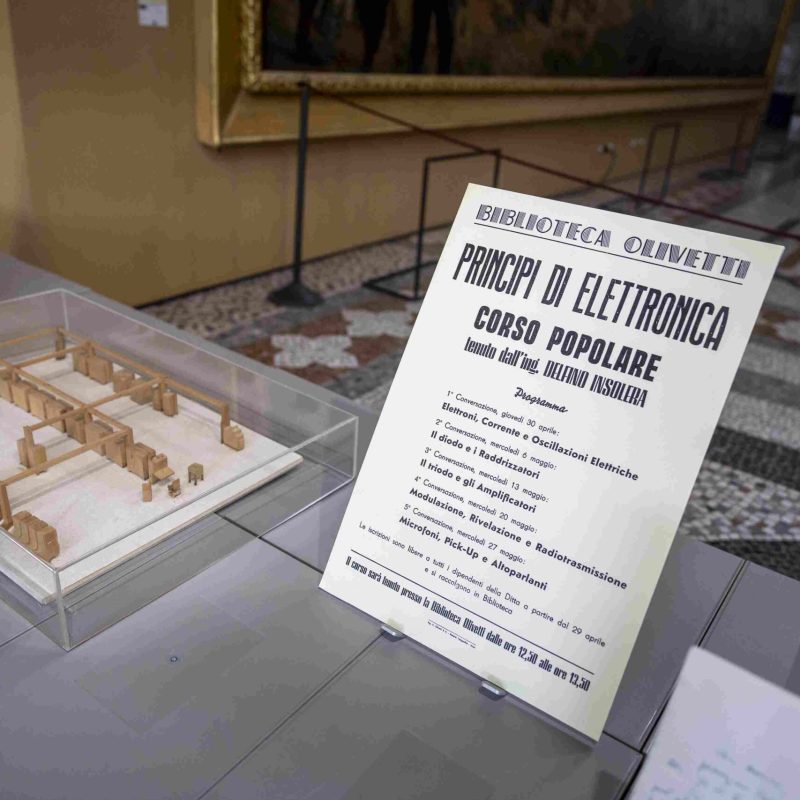
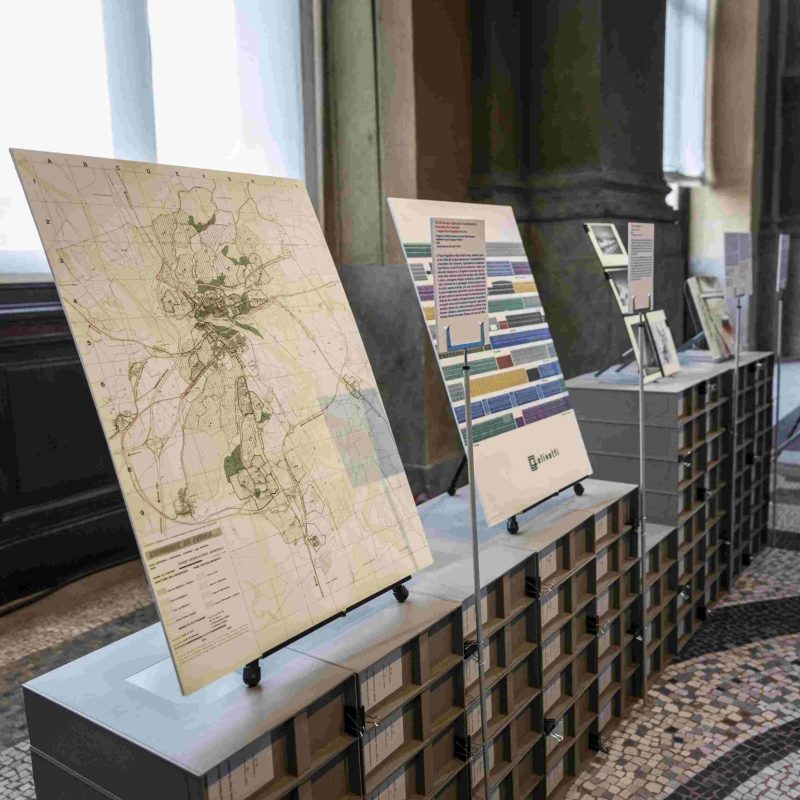
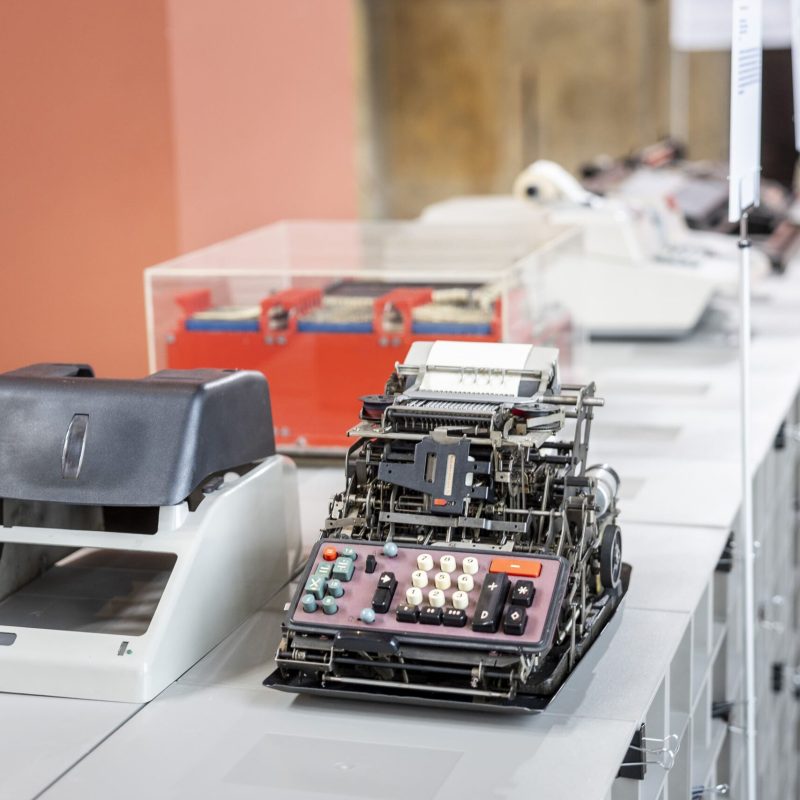
Materials from Associazione Archivio Storico Olivetti
The selection of materials from the Archivio Storico Olivetti on display spans a time frame from the 1930s to the 1970s. In the area dedicated to the city, the materials tell the story of Ivrea and the Canavese as a laboratory of integrated planning. Photographs of industrial and residential architecture, maps and urban plans – such as the studies for the Valle d’Aosta from 1943 or the Ivrea urban plan from 1955 – show how productive development, the organisation of urban space and quality of life were conceived as a unified whole. Images of factories and residential quarters for employees convey a vision of the factory and the city designed on a human scale. The work section highlights the social dimension of the enterprise. Welfare record cards from the Fondo Burzio (1930s), trade union materials such as the 1956 communication on the reduction of working hours, posters for cultural initiatives and editorial letters bear witness to a model built on welfare, participation and cultural growth. Alongside these, tools and objects related to production – such as maintenance kits and everyday materials – restore the tangible reality of the working experience. In the technology area, objects and devices are presented that marked key milestones in the history of computing and industrial design. From calculating machines such as the Divisumma 24 (1956) to early electronic computers such as the Elea 9003 (1959), through to the Programma 101 (1965) and the electronic typewriter ET 221 (1979), the pioneering role of Olivetti in developing advanced, reliable and human-centred technology comes clearly into view.
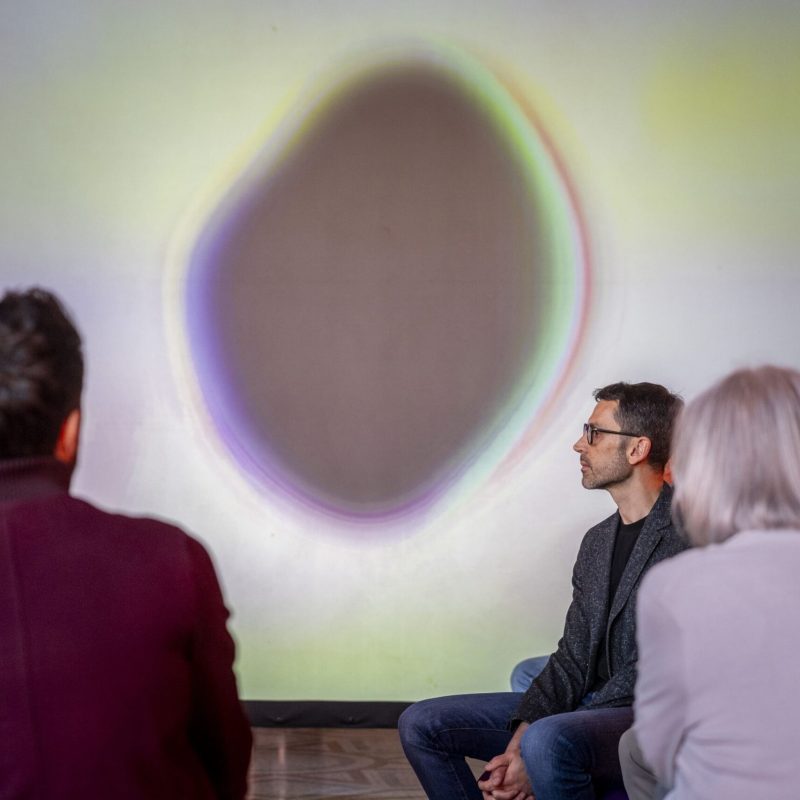
OLO
OLO is a conversational agent developed from the knowledge base of the Associazione Archivio Storico Olivetti and the contents of the Mangrovia digital magazine. It is designed to interrogate the present around the themes of the city, technology and labour.
Developed by TIM Enterprise, with an interface designed by the Possible Entanglements Lab of the Politecnico di Torino and characterisation by Sineglossa, OLO is an experiment in the role that artificial intelligences can play in the co-production of knowledge within a human-led ecosystem.
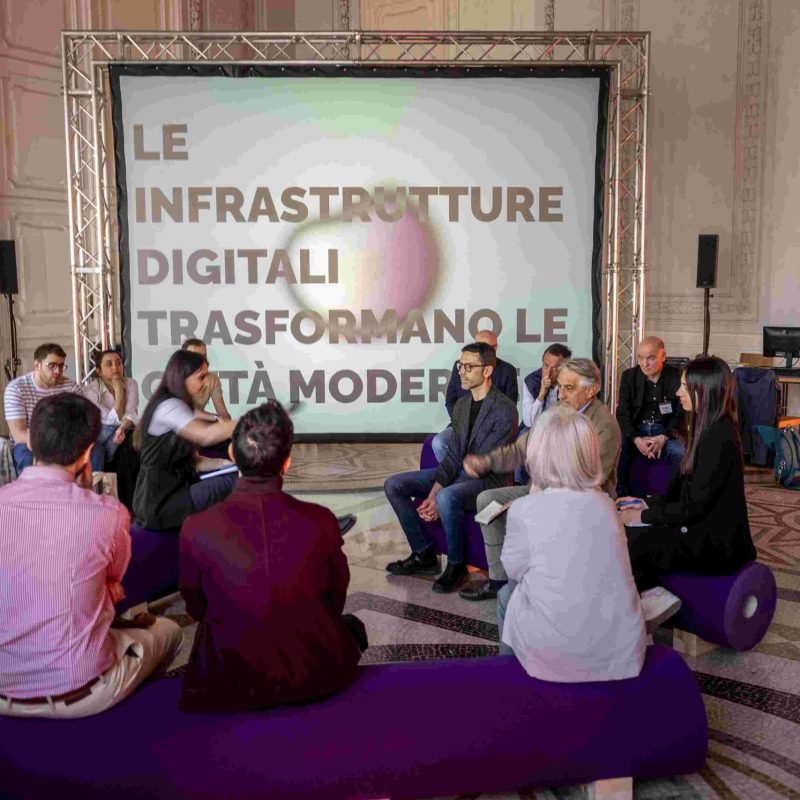
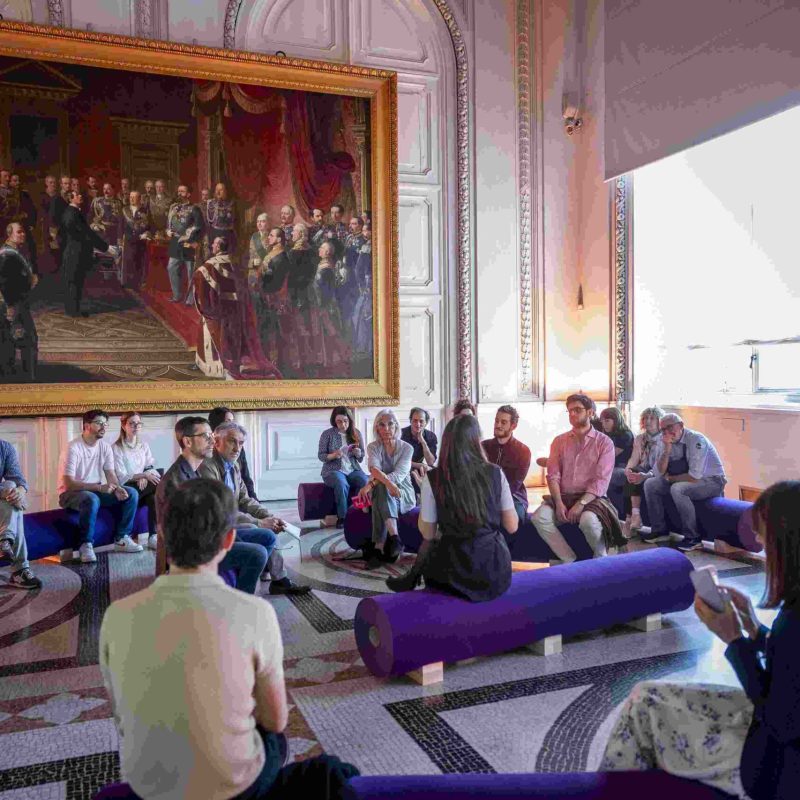
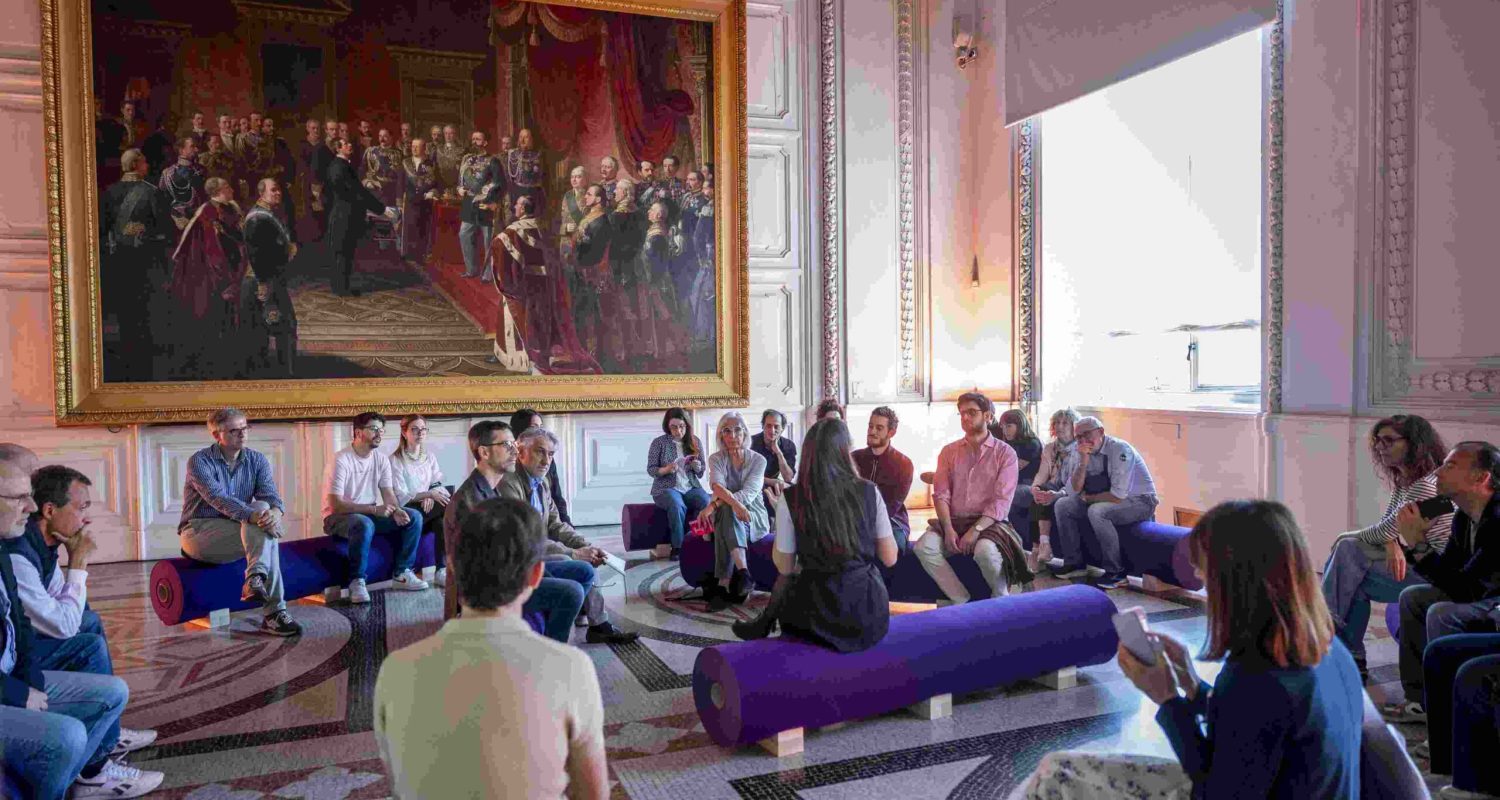
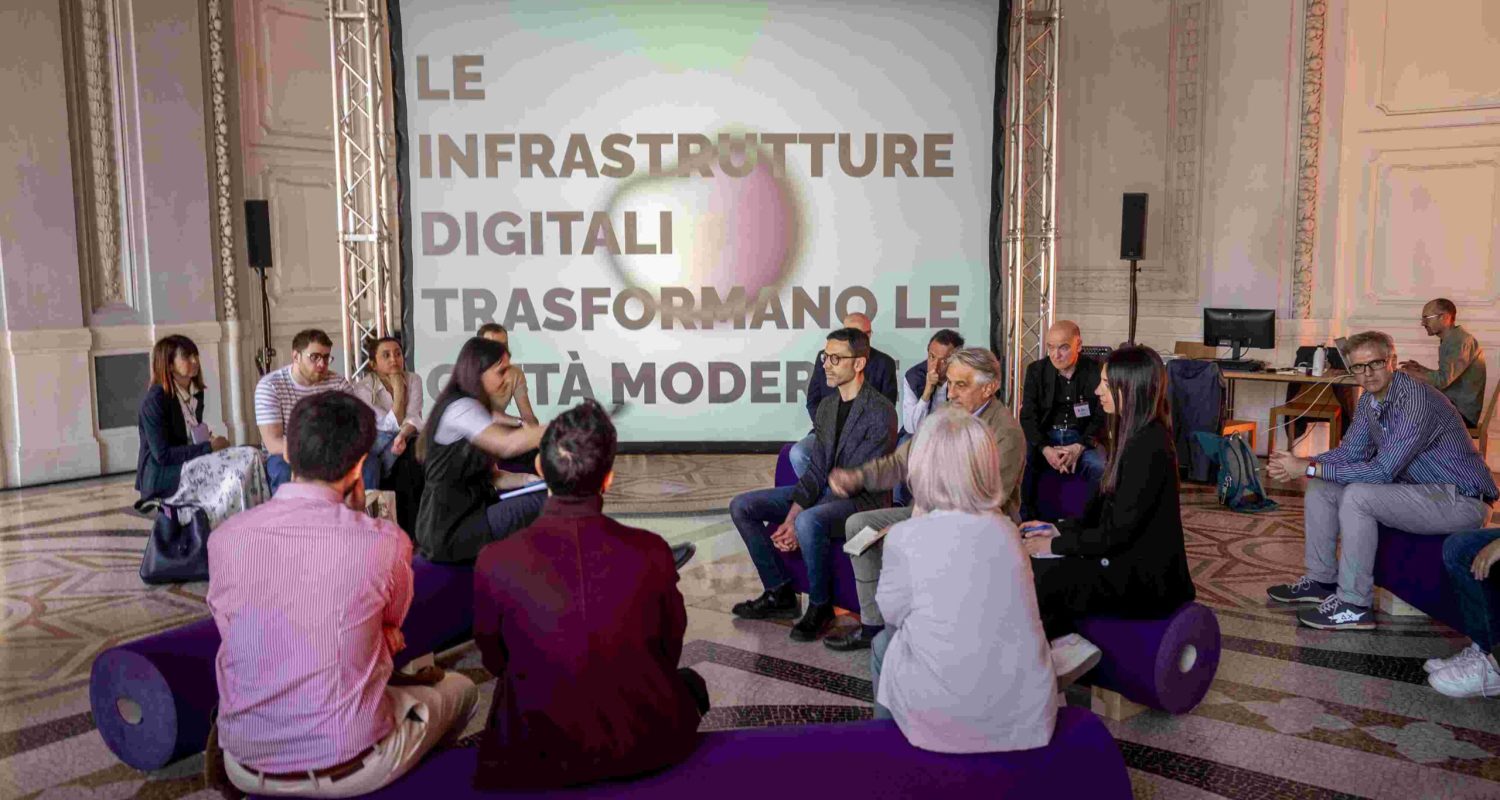
OLO is hosted in the Sala Plebisciti, dedicated to the celebration of public deliberation, where positions are transformed through dialogue. It is an “alien” entity – an other than us – that does not seek consensus, but confrontation. It does not simulate the human nor does it provide definitive answers. When activated, it listens to the conversations taking place around it and uses them as a trigger to stimulate further reactions in those it engages with. OLO acts as a maieutic device that encourages the dimension of dialogue, amplifying the role of the Museo del Risorgimento as a space for exchange between cultural institutions and digital experimentation.
Public program
Dati Sensibili Dialogue. From the archive to the production of contemporary knowledge
With Elisa Alessio, Alessandro Bollo, Gaetano Adolfo Maria di Tondo, Anna Maria Marras
Moderated by: Federico Bomba
Sala Codici, Museo Nazionale del Risorgimento Italiano, Piazza Carlo Alberto 8
Friday 17 April, 6:00 pm
Public dialogues with the chatbot OLO
curated by Centro Studi THESEUS – Technology, Society and Humanity, Politecnico di Torino
- Saturday 18 April, 12am
The future of work
In dialogue with OLO:
Gregorio Buzzelli, Politecnico di Torino, Department of Management and Production Engineering
Matteo Tubiana, Politecnico di Torino, Department of Management and Production Engineering
Armanda Cetrulo, Scuola Superiore Sant’Anna (Pisa) - Saturday 18 April, 5pm
From the urban factory to data centres: making and inhabiting the city in the age of digital infrastructures
In the twentieth century, the factory was a foundational element of the urban fabric: it organised spaces, services and social relations. Ivrea is an emblematic case. Today, major technology companies materialise their presence through large data centres which, on the one hand, appear poorly integrated into the cities that host them, yet on the other exert an impact on energy consumption, land use and local taxation. Drawing on this comparison, the session reflects on making and inhabiting the city in the age of digital infrastructures.
In dialogue with OLO:
Federica Joe Gardella, Interuniversity Department of Urban and Regional Studies and Planning, Politecnico di Torino
Rossano Schifanella, Department of Computer Science, University of Turin
Enrico Giacopelli, GStudio - Sunday 19 April, 5pm
The relevance of design between past, present and future
The Olivetti experience was defined by a profound attention to design – not only of products, but also of communication, both internal and external to the company, as well as of the living and working environments of those who were part of the Olivetti community. What has become of that experience today? And how does it relate to design practice now? Is it possible to say that a certain Olivetti approach to design has since spread into many other fields, beyond the factory walls?In dialogue with OLO:
Elena Dellapiana (design historian, Politecnico di Torino)
Matteo Moretti (information designer, Sheldon Studio and University of Sassari)
Credits
Dati Sensibili è un progetto espositivo di Biennale Tecnologia, curato da Federico Bomba (Sineglossa), con technology partner TIM Enterprise (Rossana Grazia Simeoni, Luca Buriano, Antonino Casella, Bruno Totaro Durazzi), selezione del materiale d’archivio di Associazione Archivio Storico Olivetti (Antonio Perazzo, Enrico Bandiera), interfaccia del chatbot Possible Entanglements Lab del Dipartimento di Architettura e Design, Politecnico di Torino (Elena Falomo, Eric Tron Gianet, Juri Sanni, Maria Luce Lupetti), caratterizzazione del chatbot Sineglossa, dataset del chatbot Associazione Archivio Storico Olivetti e archivio editoriale Mangrovia, mediazione culturale con chatbot a cura della redazione Mangrovia, allestimenti Studio GISTO (Alessandro Mason, Alice Fialà, Elena Festa), consulenza al progetto Giacomo Raffaelli.
Dati Sensibili (Sensitive Data) is an exhibition project by Biennale Tecnologia, curated by Federico Bomba (Sineglossa), with technology partner TIM Enterprise (Rossana Grazia Simeoni, Luca Buriano, Antonino Casella, Bruno Totaro Durazzi), archival material selection by Associazione Archivio Storico Olivetti (Antonio Perazzo, Enrico Bandiera), chatbot interface by the Possible Entanglements Lab, Department of Architecture and Design, Politecnico di Torino (Elena Falomo, Eric Tron Gianet, Juri Sanni, Maria Luce Lupetti), chatbot characterisation by Sineglossa, chatbot dataset by Associazione Archivio Storico Olivetti and the Mangrovia editorial archive, cultural mediation with the chatbot by the Mangrovia editorial team, installation design by Studio GISTO (Alessandro Mason, Alice Fialà, Elena Festa), project consultancy by Giacomo Raffaelli.