
Qui (“Here”) is a site-specific audiovisual installation designed for the Don Giuseppe Dossetti educational classroom at the Il Poggiolo Visitor Center, located within the Monte Sole Historical Park.
The project stems from a simple yet radical question: “What is Monte Sole for you?“ From this question, an experience takes shape, guiding the audience on a journey to discover the history of the Marzabotto massacres across three temporal planes: past, present, and future.
The installation treats memory not as a closed archive, but as a living medium: something that is preserved, questioned, passed down, and continuously transformed by the contributions of those who visit the Park. Visitors can ask questions, listen to fragments of historical testimony, and, in turn, leave an image, a thought, or a trace destined to join the artwork’s future archive.
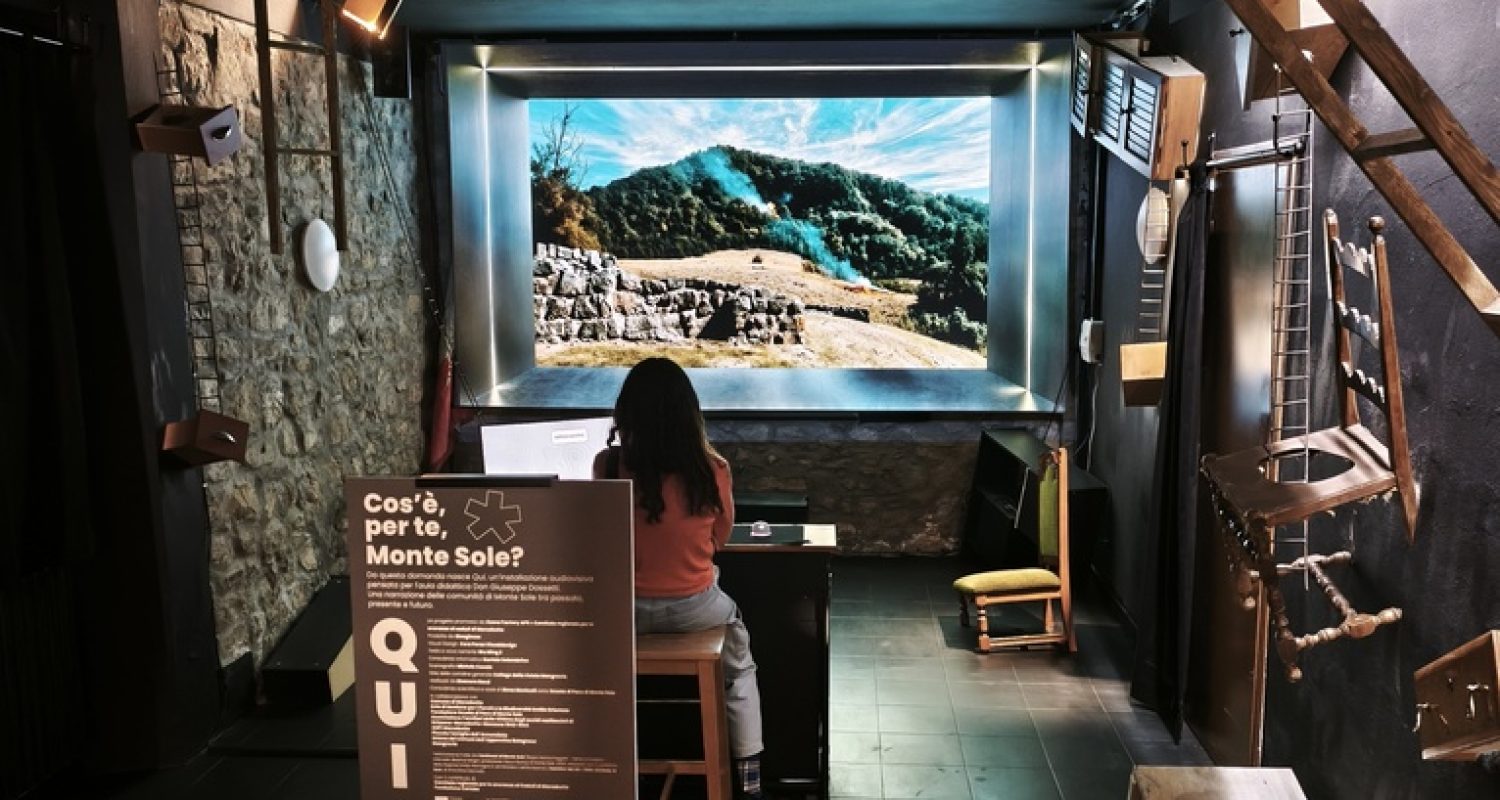
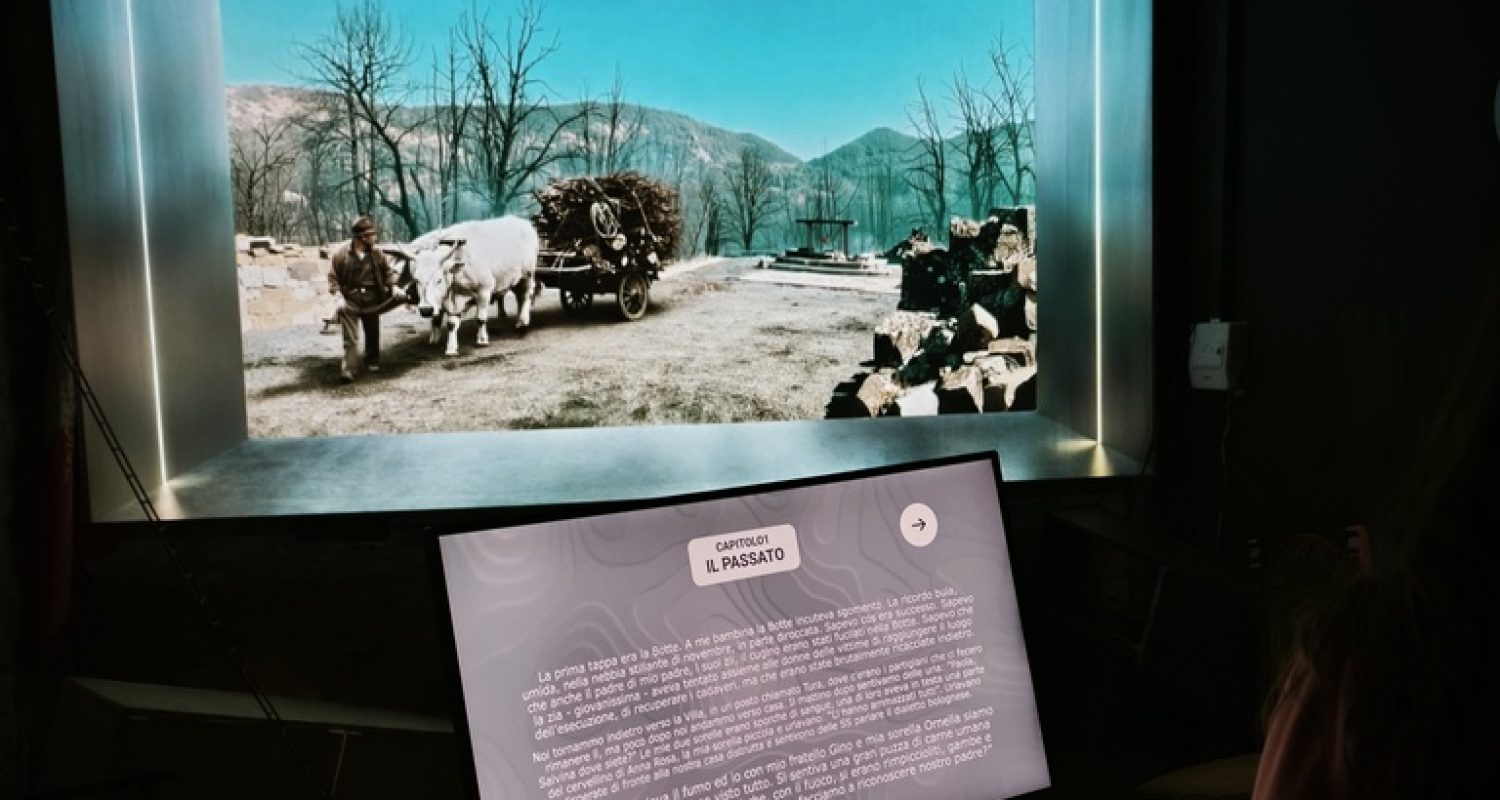
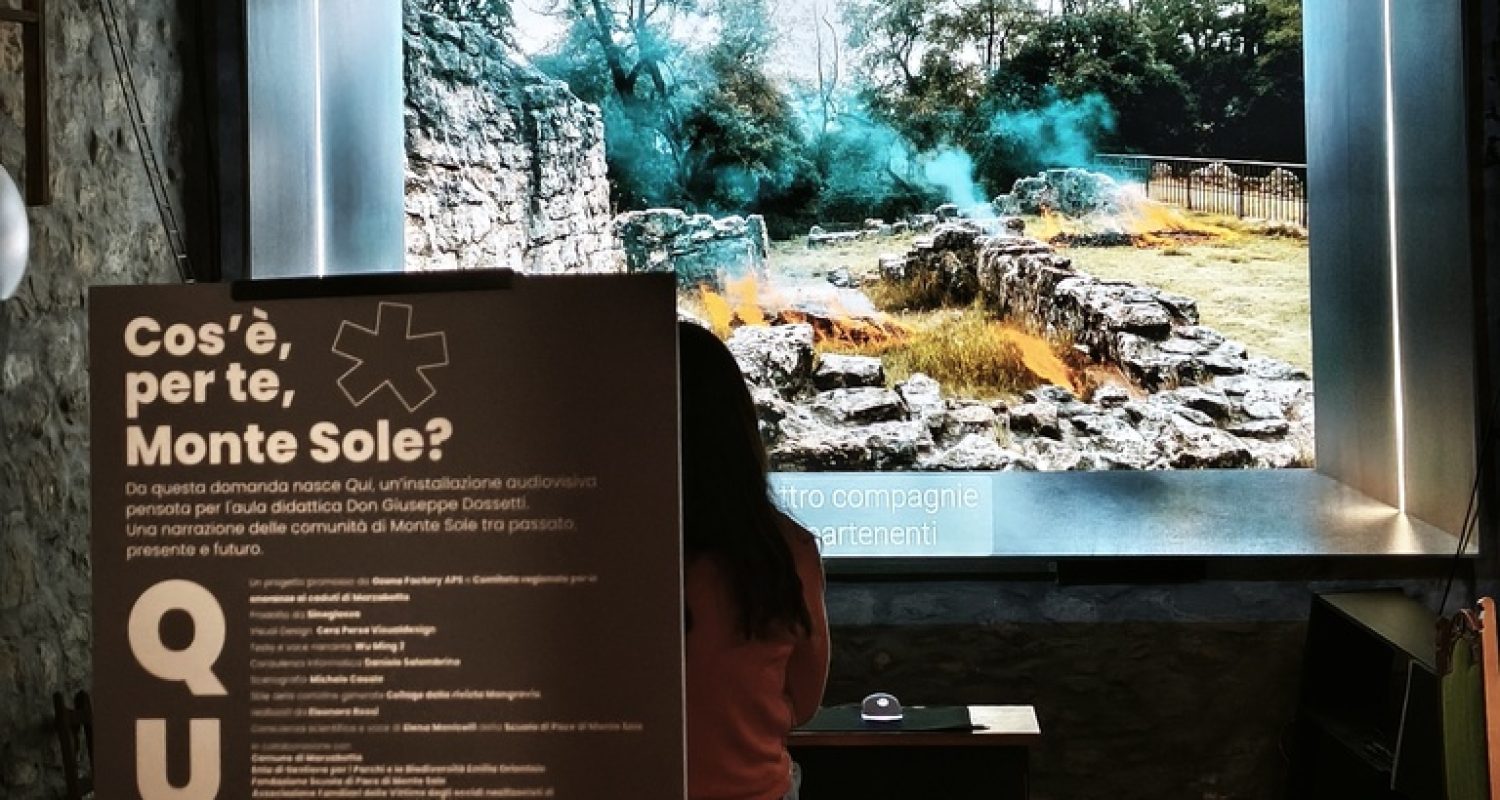
The installation
Qui creates a relationhip among three temporal planes: past, present and future.
The past is the installation’s starting point. Visitors can explore the Monte Sole archives by asking questions in natural language to a chatbot built from historical testimonies, documents, and publications. The system selects the most relevant passages and delivers them in their entirety, without altering their content. In this way, the memory of the area is not reshaped by a new narrative, but emerges directly from the voices of those who lived it and the sources that protect it.
The present is an open question about the meaning of memory and how a community continues to reckon with its own past. In the text written and narrated by Wu Ming 2, remembering is not presented as a passive, peaceful act, but as a collective responsibility: wounded communities cannot choose amnesia without risking censorship, suppression, and the return of the repressed.
The future is built through the traces left behind by those who visit the Park. At the end of the experience, visitors are invited to answer the question, “What is Monte Sole for you?” The collected testimonies are processed by a generative AI system that produces a digital postcard in the collage style of Mangrovia, Sineglossa’s magazine exploring the relationships between culture, technology, and society. The postcard is sent via email as a memento of the experience, while each new generation of inputs enriches a constantly evolving visual archive, nurished by the imaginations of the Park’s visitors.
The interface
The interface is designed as a window into a living digital archive. Through interactions with a mouse, keyboard, and monitor, visitors can consult documents, explore thematic paths, and generate new collages inspired by their own interpretation of Monte Sole. The visual component of the installation uses advanced graphic tools and artificial intelligence technologies to open an interactive digital dimension inside the physical space of the classroom.
The scenography
The scenographic setup recreates a domestic environment: a familiar, seemingly welcoming space where, however, furniture and surfaces appear cut, interrupted, or sunken into the walls and floor. The scenography translates into physical matter that which is lost, settled, or resurfacing in memory. Within the room, the set design, lighting, video projections, and video mapping unite into a single immersive experience, where technology acts as an organic part of the environment
The chatbot on Monte Sole's archives
The installation integrates a chatbot which allows visitors to question the Monte Sole archives using natural language. By means of a simple question, visitors can explore the memory of the place by interacting with a documentary corpus composed of testimonies, archives, and historical publications. The answers are not freely generated by artificial intelligence: the system exclusively selects the most relevant passages to the question and delivers them in their entirety, without altering their content. In this way, AI becomes a tool for accessing and consulting the archive, rather than an autonomous voice that interprets or rewrites history.
The chatbot’s knowledge base was built from materials sourced from the Archivio del Comitato regionale per le onoranze ai caduti di Marzabotto (Archive of the Regional Committee for Honoring the Fallen of Marzabotto), the portal eccidiomarzabotto.com, the Fondazione Scuola di Pace di Monte Sole (Monte Sole Peace School Foundation), the Piccola Famiglia dell’Annunziata, and publications dedicated to the memory of the massacres. Each testimony was segmented into coherent narrative units using artificial intelligence tools and then reviewed and validated by human curators, creating a structured and semantically organized archive.
To query this knowledge base, a system based on Large Language Models was developed, designed so that the model performs a single task: identifying the most relevant quotes in relation to the visitor’s question. The design prioritized faithfulness to the sources over the generation of new content. For this reason, specific prompt engineering strategies were adopted to restrict the model’s behavior solely to document selection, reducing the risk of hallucinations.
This attention to data governance also guided the other components of the installation. For the chatbot, only document materials that were already public and verified were used, while the generative visual component operates using models run locally, without relying on external APIs, which means the contents produced during the interaction are not uploaded online and remain archived on a dedicated computer, ensuring complete data control and safeguarde of the documentary heritage.
Credits
Qui is a project promoted by Ozono Factory APS and produced by Sineglossa. The installation is realised with visuals by Cera Persa Visualdesign, text and narrating voice of Wu Ming 2, informatic consultancy by Daniele Solombrino, scenography by Michele Casale and scientific consultancy and narrating voice of Elena Monicelli from the Comitato regionale per le onoranze ai caduti di Marzabotto. The project is realised with the support of Fondazione Carisbo and the Comitato regionale per le onoranze ai caduti di Marzabotto, in collaboration with the Comune di Marzabotto, the Ente di Gestione per i Parchi e la Biodiversità Emilia Orientale, the Fondazione Scuola di Pace, the Associazione Vittime familiari Eccidio Marzabotto, the ANPI Marzabotto, the Piccola Famiglia dell’Annunziata, the Unione dei Comuni dell’Appennino Bolognese and Re_Esistente Società Cooperativa.