
What it’s about
The reports summarizing the outcomes of the working groups held on 5 February 2026 in Bologna, at DAMA – Tecnopolo Data Manifattura Emilia-Romagna, are now available online.
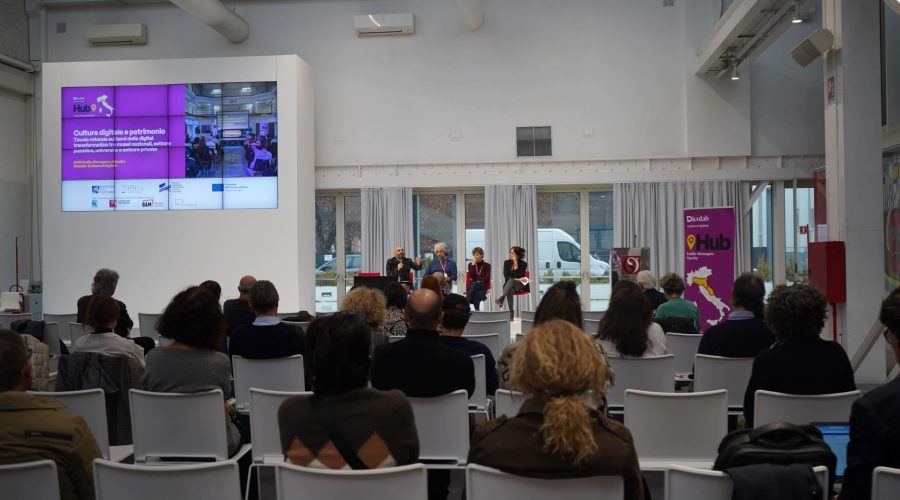
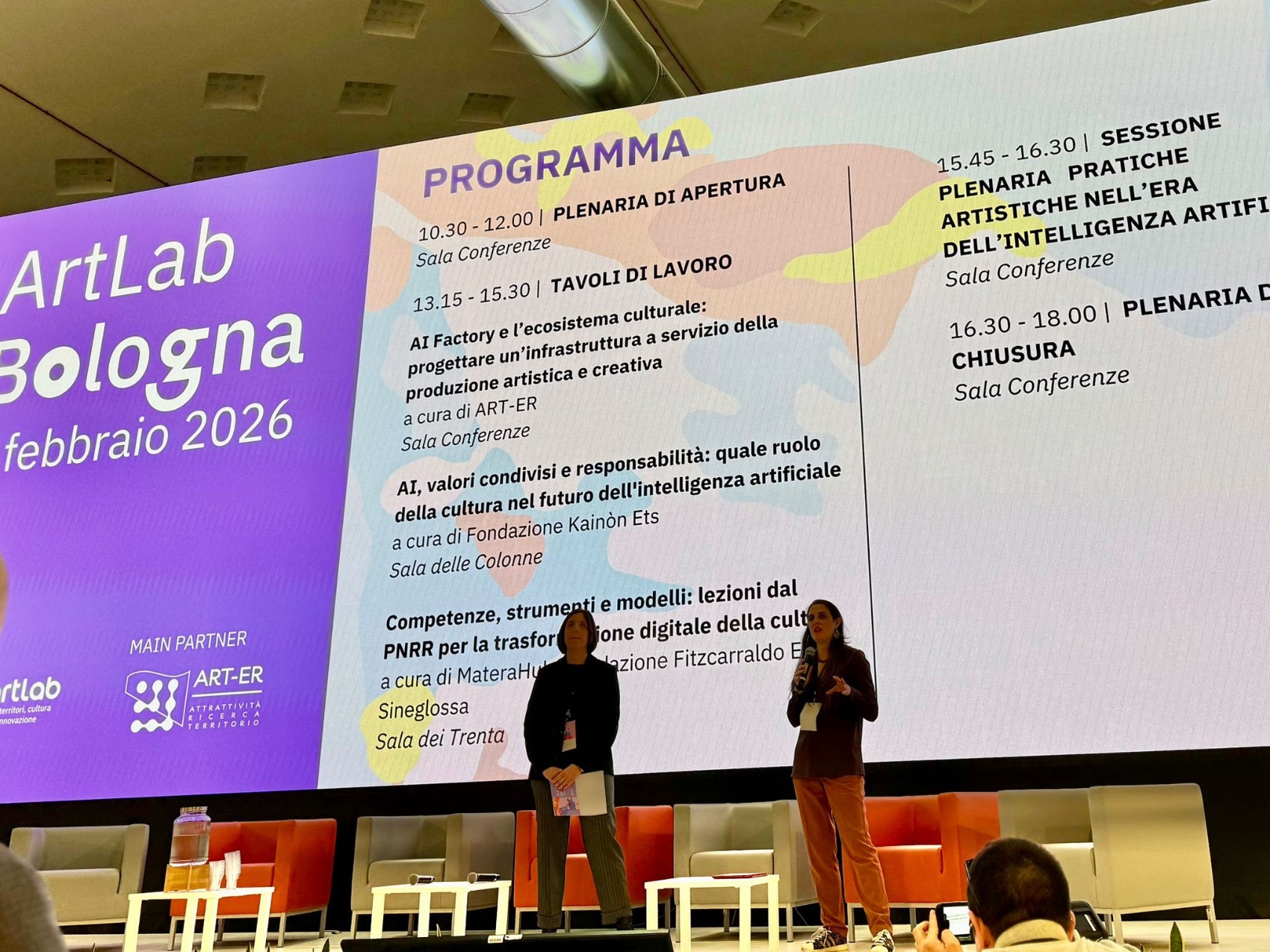
The meeting took place as part of the ArtLab Bologna satellite event dedicated to digital transformation and the challenges of artificial intelligence in cultural and creative processes. On this occasion, Sineglossa was invited to participate and moderate one of the discussion tables focused on “training and tools for the digital transformation of culture.”
The documents collect the reflections that emerged during the discussions among cultural institutions, policymakers, researchers, creative companies, and sector professionals, offering a structured overview of the debates and perspectives shaping the future of the cultural and creative ecosystem.
For Sineglossa, participation in the ArtLab event fits within an ongoing line of research and educational initiatives the organization has already explored through several training programmes (Generative Heritage, Generativa, Rigenerativa) and dedicated studies on how the cultural and creative sectors are adopting generative artificial intelligence (download the research), also with a view to enhancing cultural heritage (in this regard, Sineglossa is currently conducting a research project in collaboration with the University of Turin, which will be published in the coming days and whose preliminary reflections were recently anticipated).
What emerged from the discussions
The conversations that emerged during the working groups painted a detailed picture of the ongoing transformations in the relationship between culture, technology, and public policy. The discussions highlighted that the real challenge is not only about acquiring new infrastructures and digital tools, but above all about building collaborative ecosystems connecting institutions, research, cultural and creative enterprises, and professional communities.
Accanto alle opportunità tecnologiche, si è discusso anche delle implicazioni culturali, etiche e organizzative dell’adozione dell’AI nel settore culturale: dalla necessità di attivare infrastrutture e dataset come risorse per la produzione culturale contemporanea, al ruolo della cultura nel definire valori e responsabilità nello sviluppo dell’intelligenza artificiale, fino all’evoluzione delle competenze e dei modelli formativi necessari ad accompagnare la trasformazione digitale del settore.
Alongside technological opportunities, the groups also explored the cultural, ethical, and organizational implications of adopting AI in the cultural sector: from the need to activate infrastructures and datasets as resources for contemporary cultural production, to the role of culture in defining values and responsibilities in the development of artificial intelligence, up to the evolution of skills and educational models required to support the sector’s digital transformation.
Within this context are the reflections developed in the working groups focused on AI-based cultural production infrastructures and on the skills and models emerging from recent investment policies, discussions in which Sineglossa actively participated.
AI Factory and the cultural ecosystem
As a guest participant, Sineglossa joined the working group “AI Factory and the Cultural Ecosystem: Designing an Infrastructure for Artistic and Creative Production,” curated by ART-ER.
In the light of major investments made in recent years in heritage digitization and advanced computing infrastructures – investments which have positioned Italy and the Emilia-Romagna region at the centre of Europe’s computational capacity – the group table highlighted the need to move “from data conservation and accumulation to their cultural, symbolic and productive activation” and tried to answer the question:
how to turn such infrastructures and heritage into ecosystems capable of generating new contemporary cultural production - a competitive factor for regional socio-economic fabrics - rather than remaining limited to technical research or retrospective enhancement?
One of the main factors identified was the need to create a relational infrastructure capable of functioning as a platform for alliances between artists, developers, and institutions, whose true value would lie not only in access to hardware or datasets, but in the quality of the connections it enables.
The goal is to foster a structured dialogue between the humanities and scientific research, where technological choices are informed by cultural and social perspectives.
Another key theme concerned the use of cultural datasets as a new creative raw matter and the development of co-production processes in which creatives and developers work in integrated ways, overcoming the traditional separation between artistic conception and technical implementation.
It is not only about using AI as tool as a tool for automation or generation, but about questioning how the models learn, what they incorporate, and which worldviews they reproduce or challenge.
From the report of "AI Factory and cultural ecosystem" table
Un altro aspetto emerso dal tavolo è stata “la necessità di promuovere una padronanza etica e consapevole dell’AI, evitando sia derive puramente applicative sia entusiasmi acritici.”, sottolineando ulteriormente il bisogno di percorsi di formazione che accompagnino operatorɜ del settore in un’adozione critica e consapevole dell’IA generativa.
In recent years, Sineglossa has indeed explored such issues through artistic projects such as The Models – an installation created during an artist residency at DAMA – as well as through several works presented in Bologna during the exhibition Prompting the Real. These artistic experiments offered audiences new examples of how generative AI can act not only as a tool but as a true co-creator.
Another important point that emerged from the working group was “the need to promote an ethical and conscious mastery of AI, avoiding both purely instrumental applications and uncritical enthusiasm”, thus further highlighting the importance of training pathways that support cultural professionals in adopting generative AI in a critical and informed way.
Skills, tools and models for the digital transformation of culture
The third working group, titled “Skills, Tools and Models: Lessons from the PNRR for the Digital Transformation of Culture,” was organized and moderated by Sineglossa together with MateraHub e Fondazione Fitzcarraldo.
The discussion focused on how projects developed in recent years – specifically those funded through the PNRR and TOCC calls – have reshaped the digital training ecosystem for the cultural and creative sectors. In fact, these initiatives have expanded the range of training programmes and involved, alongside universities and traditional training institutions, non-conventional actors such as cultural enterprises and organizations where education was not a primary mission, as well as informal groups that seized the opportunity to experiment with digital-focused learning paths.
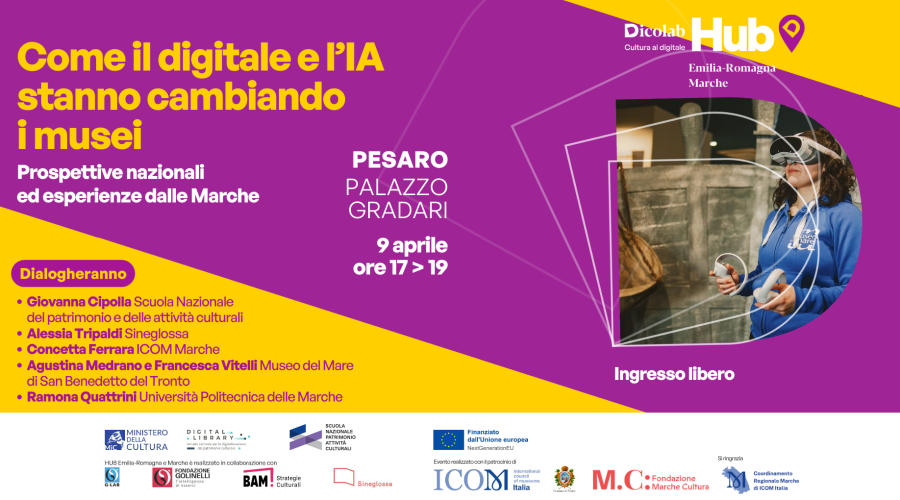
In this context, a relevant example from Sineglossa’s experience is Dicolab.Cultura al digitale, where the organization was involved in managing one of the project’s territorial hubs, key operational nodes within the initiative. Dicolab is a national training programme promoted and implemented by the Italian Ministry of Culture and the Scuola nazionale del patrimonio e delle attività culturali, operating across the country between 2025 and 2026 through 10 Hubs and involving non-traditional actors in their management.
For the Emilia-Romagna and Marche hub, the external partners included Sineglossa, G-Lab S.r.l. Impresa Sociale, Fondazione Golinelli and BAM! Strategie Culturali. These organizations – not traditionally dedicated to training – were integrated into a broader support system aimed at responding to a sector that increasingly requires flexible actors, capable of adapting to rapid change.
Nonetheless, the working group noted that the systemic conditions necessary for the long-term sustainability and “survival” of training initiatives – which are stable coordination, integration between training–research–industry, strategic use of data, consolidation of experimentation, and the adoption of competence-based approaches – tend to be easier to implement at the regional or European level, while the national level still appears to be a space that needs further definition.
Overall, the discussion highlighted both opportunities and critical challenges born from the intense phase of experimentation of the last years: the expansion of the training ecosystem has generated new possibilities, but it has also revealed a certain fragmentation, with some initiatives struggling to survive beyond the duration of the projects themselves.
The main priority results in strengthening the connections between training, research, and cultural and creative enterprises, confirming that the quality of these connections will be decisive for the future development of the sector.