“Sineglossa was born with the idea of never settling into comfortable places.”
This is the opening line of the 2025 Social Report, the third in our organization’s history: a document we try to build every year as a portrait of Sineglossa, of our cross-disciplinary approach, and of the geographies, both physical and disciplinary, that we move through.
What a Social Report is
The Social Report is a document common to all Third Sector Organizations, designed to make the work carried out transparent and its value understandable even to those unfamiliar with impact evaluation tools. It complements the financial statements and doesn’t just recount how many resources were used, but tries to answer broader questions: which people and territories have been involved? What changes have the projects generated? How consistent are the activities carried out with the organization’s mission? What goals still remain to be achieved?
To build it, we gathered quantitative and qualitative data on the projects carried out in Italy and across Europe, looking both at concrete outcomes — activities, tools and events produced — and at the impact on the people and organizations involved.
Why we publish it
For us, this isn’t just a regulatory requirement. It’s an opportunity to look at our work with greater awareness, and to share with those who follow us — partners, funders, communities — the results we’ve achieved and the directions shaping our path.
This year tells the story of a transformation
In 2025, Sineglossa surpassed, for the first time, the threshold of €1 million in revenues, income, proceeds and receipts: the threshold that, under the Third Sector Code, makes drafting a Social Report mandatory. This is the figure that best captures the leap made during the year – one that, a few months later, in May 2026, also took on a new form at the legal level, with Sineglossa’s transformation into a Social Enterprise.
Read also
- Insights, News
- Insights, News
In line with this new structure, for the first time the Social Report was submitted for review to the organization’s Supervisory Body, which verified compliance with the civic, solidarity-based and socially useful purposes set out in the statute, as well as the document’s compliance with the Guidelines of the Ministry of Labour and Social Policies: an added guarantee of transparency for those who support us, fund us, and collaborate with us.
The document’s main structure remains the same as in previous years: we organize the narrative around four thematic areas (Education and Training, Regeneration of Places, Art and Technology, Ecosystems), highlighting our contribution to the Sustainable Development Goals of the 2030 Agenda. As in the 2024 edition, we also make room for the results generated by our partners in their respective countries, because the value of a European project stems from the shared work of all the organizations that make it possible.
In the Education and Training area, the consultancy and training programs on artificial intelligence aimed at cultural institutions, museums, archives, libraries, artists and sector professionals – which in 2024 we described as an emerging strand of activity – now open the chapter: today they are the core of our work in this area, ahead of the programs dedicated to life skills and STEAM education. Artificial intelligence is no longer just a field of artistic experimentation: in 2025 we developed a conversational chatbot prototype (Eugenie) for the valorisation of cultural heritage, curated the character design of a chatbot, and held a workshop dedicated to the participatory design of a chatbot.
Do you want to know how to responsibly adopt AI?
workshop
Navigating AI
Half-day or one-day workshop
Explore the opportunities, limitations and practical applications of generative AI.
workshop
Soft skills for AI
Half-day or one-day workshop
Develop adaptability, analytical thinking, critical thinking, creative thinking and empathy to collaborate effectively with AI.
workshop
Building an AI governance
Half-day or one-day workshop
Define principles, responsibilities and decision-making criteria for integrating AI into your organisation’s processes.
Programme
Designing a Chatbot
Custom duration
Co-design a chatbot that makes collections and archives more accessible while reflecting your institution’s identity and values.
In Art and Technology, we devoted central space to The Next Real, the program that from 2024 to 2025 brought exhibitions, installations, conferences and workshops on the relationship between artificial intelligence, imagination and society to Bologna.
Among the new features of this edition, we’ve introduced a section dedicated to Sineglossa’s commitment to the ecological transition. In 2025 we took part in Green Culture, a national program promoted by Circolo del Design in collaboration with Legambiente Piemonte e Valle d’Aosta and Fondazione Sant’Agata per l’Economia della Cultura, aimed at fostering the ecological transition of the cultural and creative sector. The program allowed us to obtain an objective snapshot of the organization’s ecological maturity (61.7%, according to the 4C assessment model promoted by Fondazione Sant’Agata) and to build a three-year action plan, with 5 macro-actions, to move from sustainability implicitly practiced to sustainability that is explicit, measurable and transferable.
Taken together, these changes reflect our shift from an organization dedicated to research and artistic production to a center capable of turning what it learns into tools, services and support pathways. Research remains our starting point, but increasingly takes on different forms: a publication, an artwork, a toolkit, a guidance pathway, a workshop for a team, a chatbot designed together with a museum, or a participatory process built with a community. In 2025 this evolution was particularly evident in the field of artificial intelligence. We worked with artists and computer scientists, but also with museums, archives, universities, Third Sector organizations and cultural institutions that needed to find their bearings amid technological change, understand its risks, and identify applications consistent with their own identity. At the same time, we kept on developing projects dedicated to soft skills, the regeneration of places, cultural participation and artistic production. These are areas that don’t move separately, but influence one another: technology raises educational and political questions; regeneration requires tools for listening and facilitation; art makes visible implications that data alone cannot convey.
2025 in numbers
who took part in events, workshops and training programmes, visited works and exhibitions, or participated in activities developed together with our partners. There were over 25,000 in 2024 and 3,600 in 2023

part of an ecosystem of 213 partners and organisations

methodologies and resources developed to make knowledge and practices accessible and replicable

of training and facilitation carried out in Italia and Europe. They were 50 in 2023. di formazione e facilitazione realizzati in Italia e in Europa. Erano 50 nel 2023

among exhibitions, meetings, talks, walks and performance. They were 44 in 2024

by Sineglossa and partners in the activities carried out in Italy and Europe
public and private on project cashed in 2025. They were 316K € in 2023
from commercial activities generated through commissions, consultancy, training activities, productions and services consistent with Sineglossa’s general-interest purposes
A look in the future
As every year, the Social Report closes with the “sneak peek” section: a preview of the main activities shaping 2026. This year, the keyword running through our projects is compass: a tool for reflection, a guide for finding one’s way through complexity, without denying room for contradictions, new departures and unexpected discoveries.
This work takes shape in three publications, one for each of our areas of work:
- Education and Training: the methodology of the Stories of the Sea project (coming by the end of the year), to help facilitators and educators find their way through the creative exploration of territories together with students and local communities.
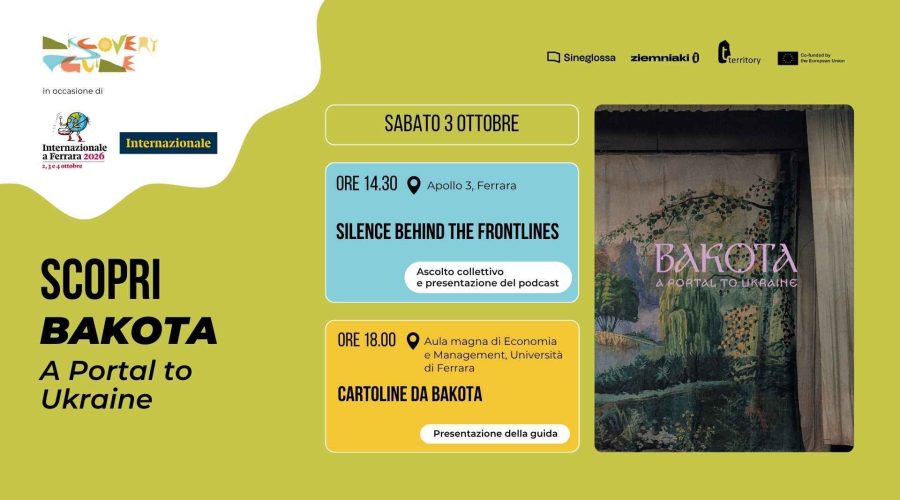
- Regeneration of Places: the guide Bakota: A Portal to Ukraine (out in September), the first international non-tourism project, to help the Bakota community and travellers find their way through the past, present and future stories of a geography reshaped by conflict.
- Art and Technology: the AI Compass report, to help the GLAM sector (galleries, libraries, archives, museums) navigate their relationship with artificial intelligence for cultural heritage promotion, between resistances, opportunities and recommendations drawn from case studies.
Single-page versione (for mobile phones):
Facing-pages versione (for desktop):