About the training program
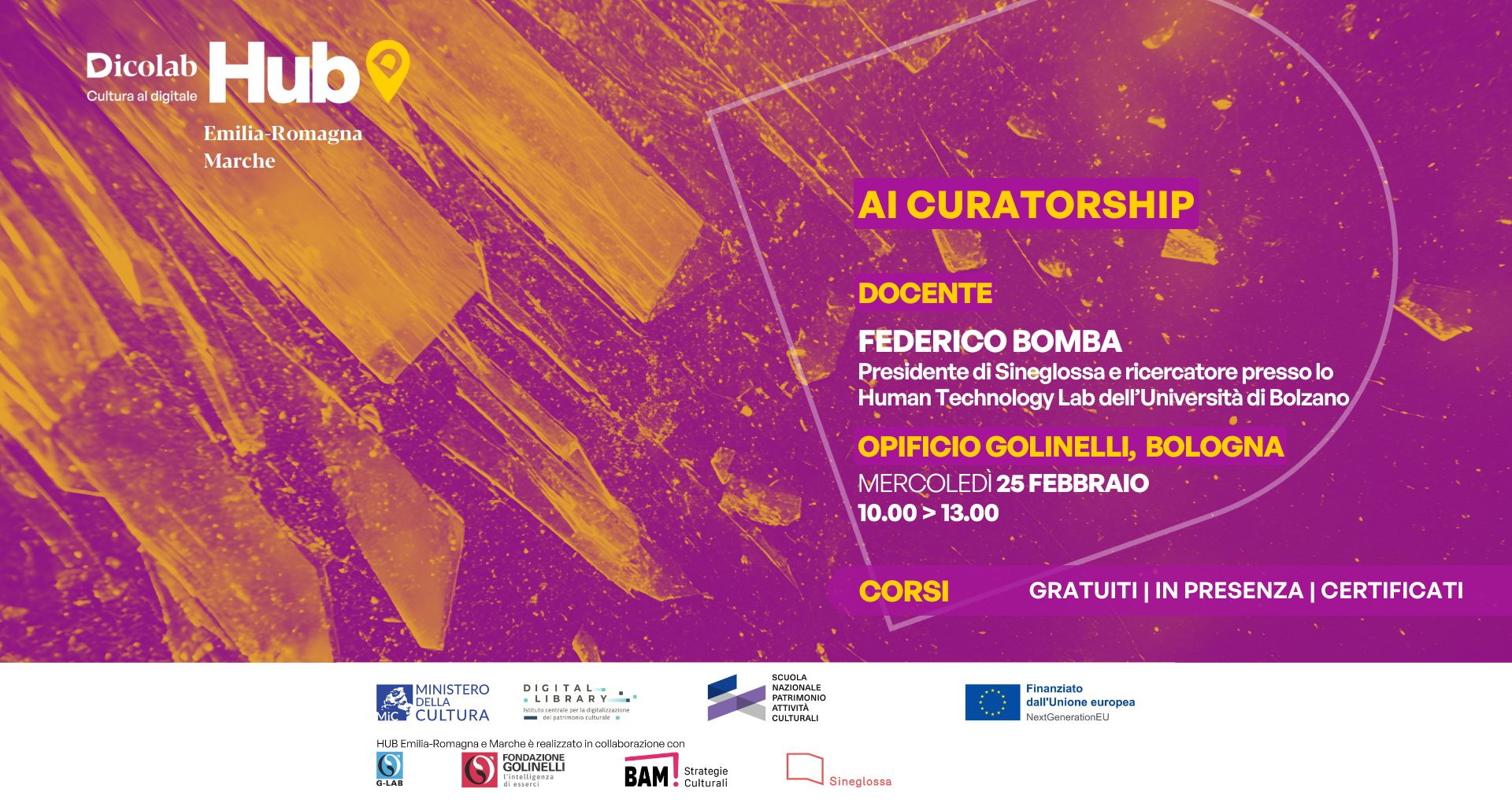
Among the first courses of the third semester of the Dicolab. Cultura al digitale Hub Emilia-Romagna and Marche — the training project focused on digital transition in the cultural heritage sector, aimed at cultural operators and the innovation ecosystem, managed by GLAB S.r.l. Impresa Sociale — a lesson on digital curatorship will take place in Bologna on 25 February.
The course will be taught by Federico Bomba, President of Sineglossa and researcher in Human-Computer Interaction at the Free University of Bozen-Bolzano. Sineglossa is a project partner alongside Fondazione Golinelli and BAM! Strategie Culturali.
From February 2025 to June 2026, the Hub offers free, in-person advanced training courses on the digital transition of the cultural sector in the cities of Bologna, Modena, Cesena, Rimini, Ravenna, Ancona, Pesaro, Reggio Emilia, and Ferrara.
Dicolab. Cultura al digitale is the new national training system for the digital transformation of cultural heritage, promoted by the Italian Ministry of Culture – Digital Library as part of the PNRR Cultura 4.0, and implemented by the Scuola del Patrimonio e delle Attività Culturali, with funding from the European Union – Next Generation EU.
The AI Curatorship course
Wednesday 25 February, 10:00–13:00
Opificio Golinelli, Bologna
Lecturer: Federico Bomba, President of Sineglossa
Language: Italian
Registration open until: 18/02/2026
About the course
The course explores the use of artificial intelligence (AI) in the curation and enhancement of cultural heritage. Participants analyze concrete applications adopted by museums and cultural institutions to improve accessibility, audience engagement, and interaction with collections. Through guided exercises, the course introduces generative AI tools to create personalized narrative content, design heritage valorization strategies, and promote cultural assets in innovative ways. The aim is to provide practical skills for integrating AI into curatorial practices and reaching new audiences.
About the lecturer
Federico Bomba is President of Sineglossa and a researcher at the Human Technology Lab of the Free University of Bozen-Bolzano. After earning a degree in Analytic Philosophy, he directed performances presented at festivals around the world until 2014, the year he founded Sineglossa, an international cultural research center. His work focuses on creating physical and digital ecosystems in which artists, scientists, entrepreneurs, policymakers, and artificial intelligences collaborate to generate economic and social development. He is a multimedia designer featured in the ADI Design Index 2017, director of The Next Rea – Art, Artificial Intelligence and Society within the Nonturismo / Ediciclo series — winner of the Best Mountain Guide 2020 — and editor of the publishing project Mangrovia.
Target audience
The course is open to:
- Staff of the Italian Ministry of Culture and other public administrations
- Employees of companies operating in the cultural heritage sector
- Professionals working in public and private cultural institutions
- Cultural heritage professionals
- Students (undergraduate and postgraduate), PhD candidates and researchers
Other upcoming courses
Cultural Heritage in the Digital Age – Co-creating New Cultural Narratives with Younger Generations
Wednesday 23 January, 10:00–13:00
Musei Civici di Reggio Emilia, Via Spallanzani 1
Lecturer: Giacomo Pompanin, photographer and digital curator, co-founder of Museodolom.it
Speaker: Fabiana Fazzi, Postdoctoral Researcher in Educational Linguistics at Ca’ Foscari University of Venice
Registration deadline: 16/01/2026
The course provides practical methodologies and operational tools to innovate educational offerings related to cultural heritage, promoting learning through co-creation and creative reuse of digitized collections. By analyzing national and international case studies and best practices, participants learn how to design educational pathways that engage younger generations in creating digital narratives inspired by cultural heritage, fostering dialogue and active participation. The program also includes hands-on experimentation with participatory methodologies, through workshop activities that explore digital tools, storytelling techniques, and interdisciplinary approaches, supporting a more inclusive, creative, and contemporary model of cultural education.