What it’s about
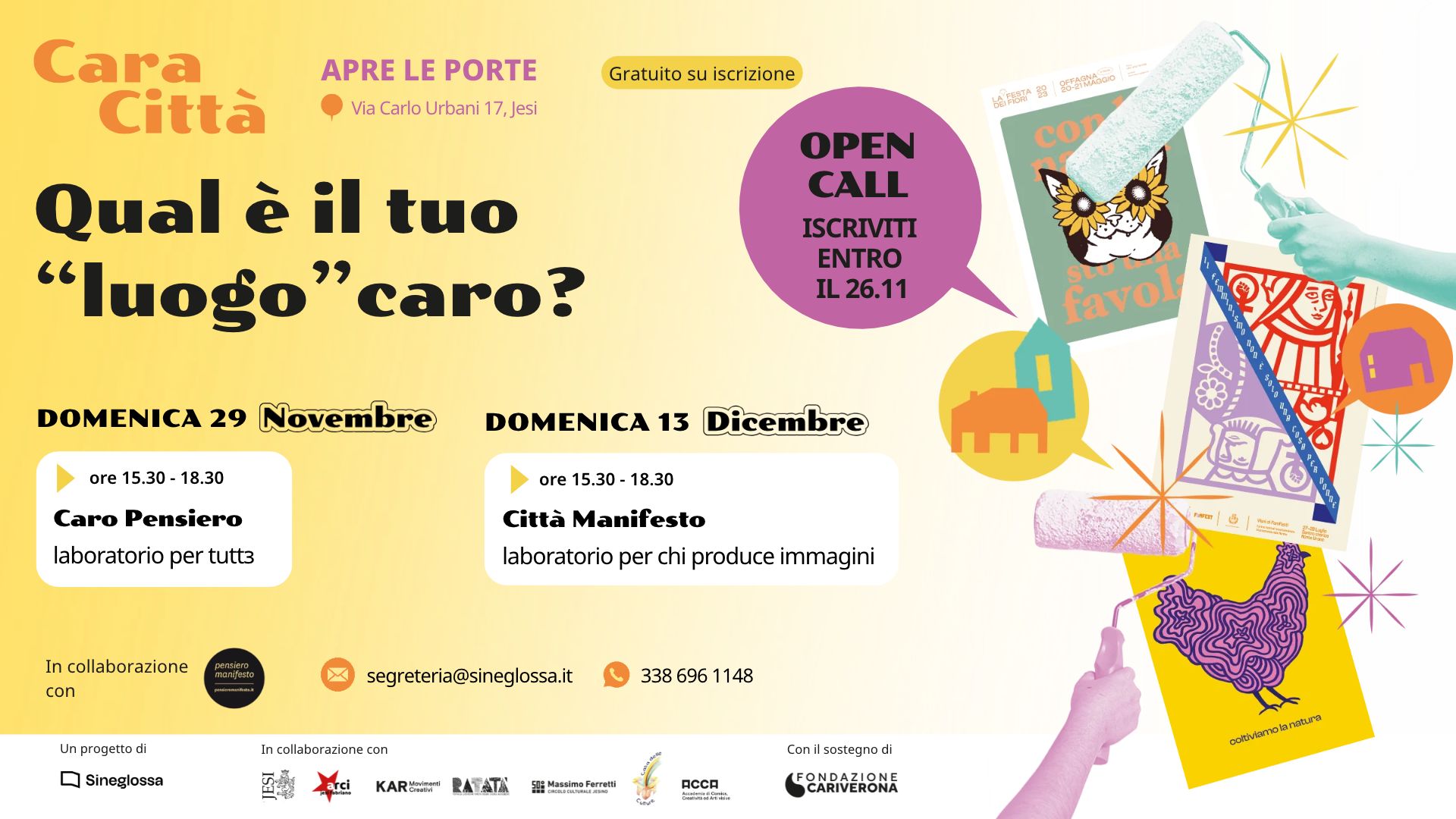
What is your “dear place”? This question is the starting point for the two free workshops that Cara Città is running with the collective Pensiero Manifesto: Caro Pensiero, on Sunday 29 November, and Città Manifesto, on Sunday 13 December. You can take part in one workshop or both. The workshops will produce billboard posters, which will be put up around the streets of Jesi in January and shown at the Cara Città party.
A dear place can be a square, a bench or a corner of your neighbourhood. It can also be an imaginary place, or an everyday activity like sewing or walking: anything we feel attached to and think of as our own.
Cara Città is the culture-led urban regeneration project we are working on in Jesi. Through it, we have given an unused municipal space back to the community: a room of about 80 m² at via Carlo Urbani 17, in the Prato neighbourhood. The idea is to make it a place open to everyone, able to host social, artistic and cultural activities that reflect what the community wants. The initiative is promoted by the Municipality of Jesi together with a network of local cultural associations: Sineglossa, Arci Jesi-Fabriano, Kar Movimenti Creativi, Ratatà, ACCA Academy, Casa delle Culture and Circolo fotografico Jesino Massimo Ferretti. It is made possible by the support of Fondazione Cariverona.
In a little over a year since it opened, Cara Città has hosted analogue photography and writing workshops that produced the Album di Quartiere, a book of photographs and texts. You can get a copy by contacting Arci Jesi-Fabriano (arci.jesi.fabriano@gmail.com). The Album also led to Ascolto, a podcast made with the Casa delle Culture of Jesi. It gathers the voices, memories and first impressions of people who came to the city from far away, crossing geographical and linguistic borders. The co-design meetings led to the space’s new activities: since June there have been sewing and filmmaking workshops, a documentary series, a reading marathon and a burraco course. The calendar keeps growing with events proposed by the Cara Città network and by the people who use the space, and the latest additions are the two workshops with Pensiero Manifesto.
Caro Pensiero: domenica 29 novembre
The first workshop is open to everyone, of any age, and requires no experience. Over three hours, participants share their dear places and play with words in small groups, together with the collective. These stories become the starting material for the second workshop: words and thoughts that will be turned into posters.
📅 Sunday 29 November, 3.30 – 6.30 pm
📍 Cara Città, via Carlo Urbani 17, Jesi
🎟️ Open to everyone, free, registration via the link
Città Manifesto: domenica 13 dicembre
The second workshop is for people who make images: photographers, illustrators, visual artists, graphic designers and enthusiasts, of any age. Twenty participants work at four tables, each one guided by members of Pensiero Manifesto, using their own tools: camera, computer, graphics tablet, pencils.
Each person creates a digital image based on the words gathered at Caro Pensiero. The collective then places it into a shared graphic format, so that all the posters speak with a coordinated voice. There are 20 places, given out in order of registration.
📅 Sunday 13 December, 3.30 – 6.30 pm
📍 Cara Città, via Carlo Urbani 17, Jesi
🎟️ For people who make images, 20 places, free, registration via the link
ℹ️ segreteria@sineglossa.it 📞 338 696 1148
Where the posters will be displayed
The posters will be exhibited at the Cara Città party, planned for January. From January they will also be put up in 50 public spaces across Jesi, in 100×140 cm format, in two rounds: from 8 January and from 27 January.
Who Pensiero Manifesto are
Pensiero Manifesto is a collective of graphic designers, artists, illustrators, photographers, video makers, anthropologists and researchers. They use the billboard poster to open a dialogue between the city and the people who live in it. For the collective, communicating means being useful: speaking up to spark discussion and to affirm the bond between a city and its inhabitants. “The billboard poster is the meeting place,” they write, “where the private becomes public, where thought turns from individual to collective.”